Former pro football running back LaDainian Tomlinson and his wife Torsha are teaming up with Kellogg’s® Snacksto help football fans make their Big Game gathering the most valuable party in the neighborhood. The Tomlinsons are dishing out quick, easy snack ideas, aided by Kellogg’s Snacks favorites. Check out these ideas:
Cheez-It Bayou Blitz Mix – Add some kick to a snack mix of Cheez-It crackers and Crispix® cereal with southern Cajun spices.
Gridiron Party Pizzas – Transform Keebler Town HouseOriginal crackers into quick-and-easy mini pizzas with this recipe.
Roasted Red Pepper Spread – Add zest to the party by sprinkling cheese dip with red peppers and garlic and serve with Keebler Club® crackers.
Rice Krispies Treats Footballs™ – Mold your Rice Krispies Treats into fun football shapes and top with caramel.
Chocolate Dipped Pringles – Dunk your favorite Pringlesvarieties into melted chocolate for a great mix of sweet and salty flavors.
Fudge Shoppe™ Fudge Stripes™ Layered Bars – Sweeten your Keebler Fudge Stripes cookies by topping them with coconut, chocolate and pecans.
Football fans - or the folks cooking for them - can find these recipes and others atwww.snackpicks.com,
Source: Kelloggs
Sunday, January 27, 2013

Friday, January 25, 2013
New Candle Fragrances for Spring 2013
Fragrance does so much to set the mood, especially candles. I change my home scents to match the season and my mood. Through the end of winter, I'll burn scents reminiscent of a snowy mountaintop - fir, evergreen and smokey wood scents. Come March, I'll be ready for something new and fresh.
When I'm ready to change for a new seasons, I look to Yankee Candle for the latest trends in home fragrence. This year, the company has announced 11 eleven new scents, five new Yankee Candle fragrances and six new fragrances in its contemporary Pure Radiance line for the spring. Inspired by memories of vacations in paradise, these candles deliver fresh beach scents and exotic fruits to create a tranquil experience.
Golden Sands™ – Your private beach awaits, where time pauses in soft breezes of soothing sandalwood, luminous orange flower and warm tonka beans.
Turquoise Sky™ – Calm, salty air with hints of sea grass and musk, float gently on ocean waves…off on an adventure beneath a bright blue sky.
Black Coconut – Sunset in paradise… rich coconut, cedarwood and island blossoms promise an evening of luxurious tranquility.
Waikiki Melon™ – Aloha! Wake up to the sunny, sweet glow of exotic, juicy melons with a touch of sweet orange oil.
Paradise Spice™ – An exotic island treasure… perfectly ripe banana and creamy vanilla, unexpectedly spiced with prized cinnamon and cloves.
NEW SPRING PURE RADIANCE™ FRAGRANCES
Sugar Flower – An irresistibly rich and artful combination of powdered sugar, pink cream and vanilla.
Stargaze™ – Warm cedar, amber and musk create a fragrant glow against a clear night sky.
Seaglass™ – Treasure the calming notes of white tea and sandalwood misted with cool salt air.
Guava – A refreshing burst of sunny tropical guava with hints of citrus zest.
Mandarin – Sweet orange is spiced with a touch of cayenne for a uniquely stimulating experience.
Promise – Soft, dewy petals of white tuberose and gardenia offer a hopeful promise of things to come.
Thursday, January 24, 2013
The "Know-it-All" Named Worst Super Bowl Party Guest, New Survey Finds
Few things can detract from the fun of Super Bowl Sunday, but a new survey reveals that some big game party guests may find themselves uninvited next year. The survey, conducted by CouponCabin.com, reveals the worst Super Bowl party guests, with the "know-it-all" – the one who knows all there is to know about football, food and the commercials – topping the list. This survey was conducted online nationwide by Harris Interactive on behalf of Coupon Cabin Jan. 14-16, 2013, among 2,050 adults ages 18 and older.
While the know-it-all is the worst party guest for 52 percent of U.S. adults, a variety of other unwelcome Super Bowl shindig attendees made the list:
- The remote dominator – the one who won't stop controlling the volume, changing the settings and flipping channels – 41 percent
- The social butterfly – the one who doesn't watch the game and doesn't stop talking – 38 percent
- The super fan – the team's biggest fan who doesn't let you forget it by showing up decked out in his/her favorite team's gear and shoots off stats left and right – 21 percent
- The dieter – the one counting calories on one of the most celebrated days of junk food – 18 percent
- The commercial watcher – the one who only pays attention during the commercials – 13 percent
"The popularity of the Super Bowl is increasing, but some are turned off by all the buildup," said Jackie Warrick , senior savings adviser at CouponCabin.com. "In fact, six-in-ten people we surveyed feel there is too much hype around the Super Bowl. It's important to keep it all in perspective, especially if you're planning to spend money hosting a party, traveling to see your team, or wagering on the outcome of the game."
 PR Newswire (http://s.tt/1ySO2)
Ok, I confess, I'm the commercial watcher... Well and the half time shows.
Bankrate: Mortgage Rates Rebound
NEW YORK, Jan. 24, 2013 /PRNewswire/ -- Fixed mortgage rates increased following positive economic news, with the benchmark 30-year fixed mortgage rate rising to 3.66 percent this week, according to Bankrate.com's weekly national survey. The average 30-year fixed mortgage has an average of 0.35 discount and origination points.
To see mortgage rates in your area, go to http://www.bankrate.com/funnel/mortgages/.
The average 15-year fixed mortgage rate jumped to a 4-month high of 2.94 percent and the larger jumbo 30-year mortgage climbed to 4.08 percent. Adjustable rate mortgages were all over the map, with the 3-year ARM increasing to 2.96 percent, the 5-year ARM dropping to 2.71 percent and the 7-year ARM holding at 2.88 percent.
The past week saw positive reports on housing starts and a drop in weekly unemployment claims, which coupled with good news on the corporate earnings front, powered mortgage rates higher. With the debt ceiling debate delayed, the most dire economic scenarios are alleviated for now, which should keep a floor under bond yields and mortgage rates at least until talk of government spending cuts heats up. Mortgage rates are closely related to yields on long-term government bonds.
The last time mortgage rates were above 5 percent was Apr. 2011. At the time, the average 30-year fixed rate was 5.07 percent, meaning a $200,000 loan would have carried a monthly payment of $1,082.22. With the average rate now 3.66 percent, the monthly payment for the same size loan would be $916.05, a difference of $166 per month for anyone refinancing now.
SURVEY RESULTS
- 30-year fixed: 3.66% -- up from 3.60% last week (avg. points: 0.35)
- 15-year fixed: 2.94% -- up from 2.89% last week (avg. points: 0.29)
- 5/1 ARM: 2.71% -- down from 2.74% last week (avg. points: 0.31)
Bankrate's national weekly mortgage survey is conducted each Wednesday from data provided by the top 10 banks and thrifts in the top 10 markets.
For a full analysis of this week's move in mortgage rates, go to http://www.bankrate.com/.
The survey is complemented by Bankrate's weekly Rate Trend Index, in which a panel of mortgage experts predicts which way the rates are headed over the next seven days. A little over half of respondents, 54 percent, expect mortgage rates to remain more or less unchanged over the coming week. Roughly three-in-eight - 38 percent – predict mortgage rates will rise and just 8 percent see mortgage rates declining over the next seven days.
For the full mortgage Rate Trend Index, go to http://www.bankrate.com/RTI.
 PR Newswire
Wednesday, January 23, 2013
Texas Ranked as One of the Most Affordable Housing Markets in the World
While the cost of home ownership around the world is on the rise, housing in the United States remains some of the most affordable in the world, according to the 9th Annual Demographia International Housing Affordability Survey, released earlier this week.
The survey covers 337 metropolitan markets in Australia, Canada, Hong Kong, Ireland, New Zealand, the United Kingdom and the United States.
Housing affordability is determined by a formula called the “Median Multiple”: median house price divided by gross, before-tax, annual median household income. The Median Multiple is a commonly used measurement tool within the financial industry and by researchers.
Historically, the median multiple has been similar in Australia, Canada, Ireland, New Zealand. the United Kingdom and the United States, the study notes. Median home prices in those countries having generally been from 2.0 to 3.0 times median household. 3.0 and under is consider affordable, while 5.1 is considered severely unaffordable.
This trend remains in the many housing markets in the United States and Canada. However, the Median Multiple has escalated sharply in the past decade in Australia, Ireland, New Zealand, and the United Kingdom and even in some markets of Canada and the United States. The one thing these rising cost markets have in common is that land use has become more restrictive. Land use impacts affordability because less land for homes means the dirt is more expensive.
In the United States, 100 markets included in the survey were below 3.0, while only 16 were over 5.1. Canada had 8 markets under 3.0 and 6 over 5.1. Australia, with the least affordable housing market, saw 30 markets over 5.1 and none in the affordable range.
Overall, Evansville, Ind., was the most affordable market in the study with a median multiple of 1.5, while Hong Kong was the least affordable in the study at 13.1. In the United States, Honolulu was the least affordable at 9.3.
In recent years, the Dallas - Fort Worth and Houston home markets have emerged as the fastest growing larger metropolitan areas, the survey noted. Both remain affordable, with a median multiple of 2.9 in Dallas-Fort Worth and 3.0 in Houston. The study credits this affordability to “liberal land use regulation” and demand driven by net domestic migration.
Texas’ Affordable Housing Markets* | Median Multiple |
Amarillo | 2.9 |
Beaumont | 2.9 |
Dallas-Fort Worth | 2.9 |
Houston | 3.0 |
Longview | 2.6 |
Lubbock | 2.0 |
*As defined by the Annual Demographia International
Housing Affordability Survey
If you're thinking of moving outside the United States, go north to Canada. New Brunswick or Moncton, New Brunswick. Both communities scored 2.3 If you're looking to get off the continent, head to Waterford Ireland, which also scored 2.3.
Whether you’re thinking about moving to the other side of town or the other side of the planet, I can help. Coldwell Banker Apex is a global company with Coldwell Banker offices in 51 countries. We can help you, your friends and family anywhere in the world. Give me a shout!
Friday, January 18, 2013
Price Reduced on Michael Jordan's Illinois Residence
Ok, this isn't exactly North Texas, but it's still fun to peak inside celebrity homes, no matter where they are!
Designed to Jordan's specific needs and taste, the property offers nine bedrooms, more than 15 baths and five fireplaces. In addition to the main residence, the estate features an attached three bedroom guesthouse, an indoor/outdoor entertaining and pool area, an outdoor tennis court, a putting green, a deep water pond and three separate climate-controlled multi-car garages. The residence was constructed between 1993 and 1995 and extensively renovated in 2009.
Among the features of the estate is the attached indoor basketball complex. Completed in 2001, the recreational facility has a separate entry and nearby parking area. It features a full size regulation basketball court with specially cushioned hardwood flooring, adjustable backstops and basket, and competition-quality high intensity lighting. The court also has a one-of-a-kind sound system with speakers expressly "tuned" to provide perfect acoustics within the court space.
 PR Newswire (http://s.tt/1yDug)
Tuesday, January 15, 2013
CoreLogic® Home Price Index Rises 7.4 Percent Year Over Year in November
Almost All States Show Positive Growth
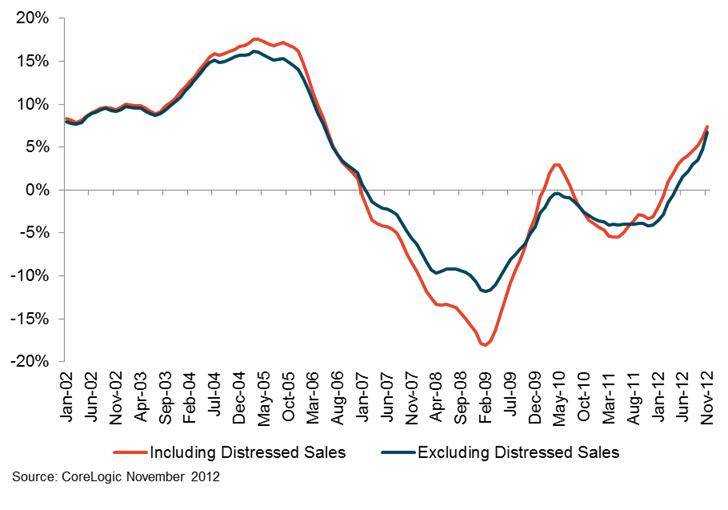
Excluding distressed sales, home prices nationwide increased on a year-over-year basis by 6.7 percent in November 2012 compared to November 2011. On a month-over-month basis excluding distressed sales, home prices increased 0.9 percent in November 2012 compared to October 2012. Distressed sales include short sales and real estate owned (REO) transactions.
 The CoreLogic Pending HPI indicates that December 2012 home prices, including distressed sales, are expected to rise by 7.9 percent on a year-over-year basis from December 2011 and fall by 0.5 percent on a month-over-month basis from November 2012 reflecting a seasonal winter slowdown. Excluding distressed sales, December 2012 house prices are poised to rise 8.4 percent year-over-year from December 2011 and by 0.7 percent month-over-month from November 2012. The CoreLogic Pending HPI is a proprietary and exclusive metric that provides the most current indication of trends in home prices. It is based on Multiple Listing Service (MLS) data that measure price changes for the most recent month.
 “As we close out 2012 the pending index suggests prices will remain strong,” said Mark Fleming, chief economist for CoreLogic. “Given that the recently released Qualified Mortgage rules issued by the Consumer Financial Protection Bureau are not expected to significantly restrict credit availability relative to today, the gains made in 2012 will likely be sustained into 2013.”
“For the first time in almost six years, most U.S. markets experienced sustained increases in home prices in 2012,” said Anand Nallathambi, president and CEO of CoreLogic. “We still have a long way to go to return to 2005-2006 levels, but all signals currently point to a progressive stabilization of the housing market and the positive trend in home price appreciation to continue into 2013.”
Highlights as of November 2012:
Including distressed sales, the five states with the highest home price appreciation were: Arizona (+20.9 percent), Nevada (+14.2 percent), Idaho (+13.8 percent), North Dakota (+11.3 percent), California (+11.1 percent).
Including distressed sales, the five states with the lowest home price depreciation were: Delaware (-4.9 percent), Illinois (-2.2 percent), Connecticut (-0.5 percent), New Jersey (-0.5 percent) and Rhode Island (-0.3 percent).
Excluding distressed sales, the five states with the highest home price appreciation were: Arizona (+16.5 percent), North Dakota (+12.9 percent), Nevada (+12.6 percent), Hawaii (+11.6 percent) and Idaho (+11.6 percent).
Excluding distressed sales, this month only two states posted home price depreciation: Delaware (-3.5 percent) and Alabama (-2.2 percent).
Including distressed transactions, the peak-to-current change in the national HPI (from April 2006 to November 2012) was -26.8 percent. Excluding distressed transactions, the peak-to-current change in the HPI for the same period was -20.7 percent.
The five states with the largest peak-to-current declines, including distressed transactions, were Nevada (-52.9 percent), Florida (-44.3 percent), Arizona (-39.8 percent), California (-35.8 percent) and Michigan (-35.4 percent).
Of the top 100 Core Based Statistical Areas (CBSAs) measured by population, only thirteen are showing year-over-year declines in November, seven fewer than in October.
*October data was revised. Revisions with public records data are standard, and to ensure accuracy, CoreLogic incorporates the newly released public data to provide updated results.
November HPI for the Country’s Largest CBSAs by Population (Sorted by Single Family Including Distressed)
November National and State HPI (Sorted by Single Family Including Distressed)
Figure 1 - Home Price Index
Percentage Change Year-Over-Year
HPI Single-Family Combined Series
12-Month Change by State
HPI Single-Family Combined Excluded Distressed Series
12-Month Change by State
“For the first time in almost six years, most U.S. markets experienced sustained increases in home prices in 2012,” said Anand Nallathambi, president and CEO of CoreLogic. “We still have a long way to go to return to 2005-2006 levels, but all signals currently point to a progressive stabilization of the housing market and the positive trend in home price appreciation to continue into 2013.”
Highlights as of November 2012:
Including distressed sales, the five states with the highest home price appreciation were: Arizona (+20.9 percent), Nevada (+14.2 percent), Idaho (+13.8 percent), North Dakota (+11.3 percent), California (+11.1 percent).
Including distressed sales, the five states with the lowest home price depreciation were: Delaware (-4.9 percent), Illinois (-2.2 percent), Connecticut (-0.5 percent), New Jersey (-0.5 percent) and Rhode Island (-0.3 percent).
Excluding distressed sales, the five states with the highest home price appreciation were: Arizona (+16.5 percent), North Dakota (+12.9 percent), Nevada (+12.6 percent), Hawaii (+11.6 percent) and Idaho (+11.6 percent).
Excluding distressed sales, this month only two states posted home price depreciation: Delaware (-3.5 percent) and Alabama (-2.2 percent).
Including distressed transactions, the peak-to-current change in the national HPI (from April 2006 to November 2012) was -26.8 percent. Excluding distressed transactions, the peak-to-current change in the HPI for the same period was -20.7 percent.
The five states with the largest peak-to-current declines, including distressed transactions, were Nevada (-52.9 percent), Florida (-44.3 percent), Arizona (-39.8 percent), California (-35.8 percent) and Michigan (-35.4 percent).
Of the top 100 Core Based Statistical Areas (CBSAs) measured by population, only thirteen are showing year-over-year declines in November, seven fewer than in October.
*October data was revised. Revisions with public records data are standard, and to ensure accuracy, CoreLogic incorporates the newly released public data to provide updated results.
November HPI for the Country’s Largest CBSAs by Population (Sorted by Single Family Including Distressed)

November National and State HPI (Sorted by Single Family Including Distressed)

Figure 1 - Home Price Index

Percentage Change Year-Over-Year
HPI Single-Family Combined Series

12-Month Change by State
HPI Single-Family Combined Excluded Distressed Series

12-Month Change by State
Thursday, January 10, 2013
USDA Loans: Homeownership Could Be Within Your Reach with a USDA Rural Development Single Family Housing Guaranteed Loan Program
A few days ago, I had lunch with a friend of mine, a single mom with two kids. During the course of the conversation, she lamented the aggravations of apartment dwelling, and that she would love to get her own place, a place with a yard, but was afraid with her income, it would never happen.
As a realtor, I stay on top of the various loan programs out there, and I turned her on to the USDA’s Rural Development Single Family Housing Guaranteed Loan Program. This loan is designed for people just like my friend. The purpose of this loan program is to assist low to moderate income rural homebuyers achieve their dream of homeownership. The loan program requires no down payment, offers 100 percent financing and a 30-year fixed interest rate, doesn’t require private mortgage insurance (also called PMI), and has no restrictions on size or design of the home.
Initially, she balked at the idea of living in a “rural” community, but I quickly explained that “rural” doesn’t necessarily mean middle of nowhere. Many communities in easy driving distance of Dallas, Fort Worth and many other employment centers are eligible for the program. Examples include Anna, Melissa, Princeton, Prosper, Farmersville, Fate, and Royse City among many others. And there’s many subdivisions in those communities - new and established - to choose from.
The program does have eligibility requirements. Since the loan is designed for low to moderate income homeowners, there are income caps. In general, a family of up to four individuals living in Texas can make $74,750; families up to eight members can make up to $98,650.
There are exceptions for high income for some geographic regions of the state, including North Texas. In Collin, Dallas, Delta, Denton, Ellis, Hunt, Kaufman and Rockwall counties, the limits are $80,650 for a family up to four members and $106,450 for a family up to eight. In Johnson, Parker, and Tarrant counties the limits are $79,550 and $105,000, respectively. Wise County the limit is $77,250 and $101,950. Again, not all of the counties have communities that are eligible for the loan program. For the latest on income and property eligibility, click here.
While there is no maximum purchase price, per se, qualifying ratios, credit scores, stable and dependable income, and other criteria determine the top amount the applicant can borrow. In general, lenders are looking for a credit score of 620-640 and the housing cost should be no more than 29 percent of the applicant’s income while the applicant’s total debt should be no more than 41 percent of their income.
My friend also expressed concern that she’d owned a house before and that would make her ineligible. No worries, I told her. The program isn’t limited to first-time home buyers.
For now, my girlfriend is marking time until her lease is up, but by the time the next school year rolls around, I’m confident we’ll have her tucked into a new home of her own.
Ready for a home of your own? I’m here to help! I know of many wonderful subdivisions in areas that are eligible for this program! And I can refer you to mortgage professionals who can guide through the loan process. Want to know more? Drop me a email now.
Tuesday, January 8, 2013
Getting Started with Your VA Loan
A VA-guaranteed loan is a fabulous benefit offered to hard-working men and women who have served or are serving in the U.S. military. Some of the benefits available only through a VA loan includes the opportunity to refinance your home up to 100 percent of its value, and purchase a home with no down payment.
A VA loans also eliminates the private mortgage insurance premium requirement and limits the amount you can be charged for closing costs. The seller also can pay your closing costs. VA-backed loans can't charge you a penalty if you pay off your loan early. Also, the VA may be able to help if you find yourself struggling to make payments.
You can use a VA-backed loan to:
To qualify for a VA loan, you have to prove that you meet one of the following requirements:
To show that you are eligible for a VA loan, you must get a Certificate of Eligibility (COE) or Form 26-1880 from the Veterans Association. The documents you need to request the COE depends on the category of your eligibility. Click here for a list of documents you'll need.
There are three ways to apply for the COE - online, via snail mail or through your lender. If you apply directly, it could take up to six weeks before you get a response, so make sure you request the certificate very early in your home search.
You also have to suitable credit and sufficient income as well. Though there are some exceptions, the VA will guarantee up $417,000. Your lender can help you determine your loan amount.
While VA loans require no down payment, borrowers do have to pay a funding fee. This fee, which can be as high as 3.3% is based on how much you do put down, whether this is your first or subsequent VA loan and whether you're regular military or reserve/National Guard. These fees are waved for vets classified as disabled by the VA.
If you're a veteran or an active service member, let me help guide you through the entire homebuying process. I can refer you to mortgage professionals who can help you find the best VA lender to help you meet your needs. Want to know more? Drop me a email now.
A VA loans also eliminates the private mortgage insurance premium requirement and limits the amount you can be charged for closing costs. The seller also can pay your closing costs. VA-backed loans can't charge you a penalty if you pay off your loan early. Also, the VA may be able to help if you find yourself struggling to make payments.
You can use a VA-backed loan to:
- Buy a home, a condominium unit in a VA-approved project
- Build a home
- Simultaneously purchase and improve a home
- Improve a home by installing energy-related features or making energy efficient improvements
- Buy a manufactured home and/or lot.
To qualify for a VA loan, you have to prove that you meet one of the following requirements:
- Served 181 days during peacetime (Active Duty)
- Served 90 days during war time (Active Duty)
- Served 6 years in the Reserves or National Guard
- Be the surviving spouse of a service member who was killed in the line of duty.
Click here for more detail
.To show that you are eligible for a VA loan, you must get a Certificate of Eligibility (COE) or Form 26-1880 from the Veterans Association. The documents you need to request the COE depends on the category of your eligibility. Click here for a list of documents you'll need.
There are three ways to apply for the COE - online, via snail mail or through your lender. If you apply directly, it could take up to six weeks before you get a response, so make sure you request the certificate very early in your home search.
You also have to suitable credit and sufficient income as well. Though there are some exceptions, the VA will guarantee up $417,000. Your lender can help you determine your loan amount.
While VA loans require no down payment, borrowers do have to pay a funding fee. This fee, which can be as high as 3.3% is based on how much you do put down, whether this is your first or subsequent VA loan and whether you're regular military or reserve/National Guard. These fees are waved for vets classified as disabled by the VA.
If you're a veteran or an active service member, let me help guide you through the entire homebuying process. I can refer you to mortgage professionals who can help you find the best VA lender to help you meet your needs. Want to know more? Drop me a email now.
Monday, January 7, 2013
Americans Continue to Expect Growth in Home Prices
Fiscal Cliff Debate Appears to Rattle Overall Economic and Financial Confidence
"The highest share of consumers in the survey's two-and-a-half-year history expect home prices to increase in the next 12 months. This view is consistent with Fannie Mae's expectation that home prices will rise going forward on a national basis. Combined with consumers' growing mortgage rate and rental price increase expectations, the positive home price outlook could incentivize those waiting on the sidelines of the housing market to buy a home sooner rather than later and thus support continued housing acceleration," said Doug Duncan , senior vice president and chief economist of Fannie Mae. "Despite continued strengthening in the housing market, consumers' concerns over the fiscal cliff and debt ceiling have caused considerable volatility in their perceptions of the larger economy. This uncertainty seems to be prompting a growing share of consumers to expect their personal finances to worsen and may contribute to weaker near-term economic growth."
SURVEY HIGHLIGHTS
Homeownership and Renting
- The average 12-month home price change expectation jumped to 2.6 percent, the highest level since the survey's inception in 2010.
- At 43 percent, the share who believe home prices will go up in the next 12 months reached the highest level recorded, up 6 percentage points over November.
- The percentage who think mortgage rates will go up continued to rise, increasing by 2 percentage points to 43 percent, the highest level since August 2011.
- Twenty-one percent of respondents say it is a good time to sell, a 2 percentage point decrease from last month's record high, but a 10 percentage point increase year over year.
- At 4.4 percent, the average 12-month rental price expectation hit the highest level since the survey's inception, up 0.4 percent over last month.
- Forty-nine percent of those surveyed say home rental prices will go up in the next 12 months, a slight increase from last month.
- The share of respondents who said they would buy if they were going to move decreased slightly to 66 percent.
The Economy and Household Finances
- At 39 percent, the share of respondents who say the economy is on the right track fell by 5 percentage points from last month's survey high.
- The percentage who expect their personal financial situation to get worse over the next 12 months continued to rise, reaching 20 percent and the highest level sinceAugust 2011.
- Twenty-two percent of respondents say their household income is significantly higher than it was 12 months ago, a slight increase over last month and a 5 percentage point increase over September.
- Thirty-seven percent reported significantly higher household expenses compared to 12 months ago, a 3 percentage point increase over the past month and the highest level since December 2011.
The most detailed consumer attitudinal survey of its kind, the Fannie Mae National Housing Survey polled 1,002 Americans via live telephone interview to assess their attitudes toward owning and renting a home, mortgage rates, homeownership distress, the economy, household finances, and overall consumer confidence. Homeowners and renters are asked more than 100 questions used to track attitudinal shifts (findings are compared to the same survey conducted monthly beginning June 2010). Fannie Mae conducts this survey and shares monthly and quarterly results so that we may help industry partners and market participants target our collective efforts to stabilize the housing market in the near-term, and provide support in the future.
For detailed findings from the December 2012 survey, as well as a podcast providing an audio synopsis of the survey results and technical notes on survey methodology and questions asked of respondents associated with each monthly indicator, please visit the Fannie Mae Monthly National Housing Survey site. Also available on the site are quarterly survey results, which provide a detailed assessment of combined data results from three monthly studies. The December 2012 Fannie Mae National Housing Survey was conducted between December 3, 2012 and December 18, 2012. Interviews were conducted by Penn Schoen Berland, in coordination with Fannie Mae.
Opinions, analyses, estimates, forecasts, and other views of Fannie Mae's Economic & Strategic Research (ESR) Group included in these materials should not be construed as indicating Fannie Mae's business prospects or expected results, are based on a number of assumptions, and are subject to change without notice. How this information affects Fannie Mae will depend on many factors. Although the ESR Group bases its opinions, analyses, estimates, forecasts, and other views on information it considers reliable, it does not guarantee that the information provided in these materials is accurate, current, or suitable for any particular purpose. Changes in the assumptions or the information underlying these views could produce materially different results. The analyses, opinions, estimates, forecasts, and other views published by the ESR Group represent the views of that group as of the date indicated and do not necessarily represent the views of Fannie Mae or its management.
Fannie Mae is a leading provider of mortgage credit in the United States. We guarantee and purchase loans so that families can buy homes, refinance their existing mortgages, or access affordable rental housing. Fannie Mae is focused on assisting homeowners in distress, stabilizing neighborhoods, and encouraging sustainable lending. We are committed to improving our financial condition and our priorities are aligned with the public interest. Our work supports the housing recovery today and is helping to build a better housing finance system for the future.
SOURCE Fannie Mae
 PR Newswire (http://s.tt/1y3sT)
Subscribe to:
Posts (Atom)