Showing posts with label Health. Show all posts
Showing posts with label Health. Show all posts
Sunday, October 2, 2016
Making Sure 'Healthy' Means What It Says on Food Packages
With final rules on the Nutrition Facts label published, consumers soon will see an updated label on food packages that makes the calories and serving sizes of products easier to see and that gives them additional nutrition information, such as added sugars, vitamin D, and potassium.
The marketplace is teeming with rows and rows of foods – some new and some not; some healthier than others. Even for the well informed, choosing what to buy is challenging, especially if you want to choose a healthy diet for you and your families.
We know that many consumers use the Nutrition Facts label, especially when they are buying a food for the first time. Often, there are also a lot of other terms on food packages such as "healthy," "low in fat,"or "good source." We also know that many just don't have the time to consider the details of nutrition information on every package they purchase. In fact, most purchase decisions are made quickly, within three to five seconds.
That's why we're looking at how we define the claim "healthy." Companies can use this and other claims on the front of packages of foods that meet certain criteria to help consumers quickly identify nutritious choices.
As our understanding about nutrition has evolved, we need to make sure the definition for the "healthy" labeling claim stays up to date. For instance, the most recent public health recommendations now focus on type of fat, rather than amount of fat. They focus on added sugars, which consumers will see on the new Nutrition Facts label. And they focus on nutrients that consumers aren't getting enough of, like vitamin D and potassium. By updating the definition, we hope more companies will use the "healthy" claim as the basis for new product innovation and reformulation, providing consumers with a greater variety of "healthy" choices in the marketplace.
We have started to consider the criteria or terms for an updated definition of "healthy" but don't have all the answers. As a first step, we are asking for public input on a range of questions about what "healthy" should mean from a nutrition perspective and how consumers understand and use "healthy" food label claims.
For example, what current dietary recommendations should be reflected in the definition of "healthy"? What are the public health benefits of defining the term "healthy"? What do consumers expect of foods that carry a "healthy" claim? What factors and criteria should be used for the new definition of "healthy"? We are also planning to hold public forums to get additional input and inform us of what a broad range of stakeholders and consumers think. This may take some time, but we want to get it right.
While we are considering how to update the term "healthy" as a nutrient content claim, food manufacturers can continue to use the term "healthy" so long as certain criteria are met.
While we are working on the "healthy" claim, we also will begin evaluating other label claims to determine how they might be modernized. We want to give consumers the best tools and information about the foods they choose, with the goal of improving public health. And, we will also engage with industry to explore other ways to encourage companies to change their products to have better nutrition profiles. The end result will be more healthy dietary choices for consumers, and that is a worthy goal.
Douglas Balentine, Ph.D., is Director, Office of Nutrition and Food Labeling at FDA's Center for Food Safety and Applied Nutrition

Sunday, September 25, 2016
FDA CONSUMER HEALTH INFORMATION: What's in a Name? What Every Consumer Should Know About Foods and Flavors
Many foods or beverages are flavored—but how can you tell where those flavors come from?
For example, if you're digging into a bowl of cereal that has the word "maple" on the package, and even images of maple leaves, you may think you're eating a product that contains maple syrup. But not so fast—the taste may come from added flavors.
The same goes for the lemon drink you've made from a package picturing fresh lemons. You probably think it was made with lemons, but it may be flavored with natural or artificial lemon flavor.
Why?
Current regulations allow use of terms like "maple," "maple-flavored," or "artificially maple-flavored" on the food label without having any maple syrup in the product, as long as it contains maple flavoring. This flavoring could come from a number of sources, including sap or bark from the maple tree. Or it could come from the herb fenugreek, which can impart a maple-like flavor.
Likewise, a lemon-flavored food or drink doesn't necessarily have to contain lemons or lemon juice. However, this food has to be properly labeled if the source of the flavor is not from lemons. For example, if the flavor comes from an artificial source or a source other than lemon, the product's name must reflect artificial lemon flavor. And if a strawberry shortcake is made with artificial strawberry flavoring, it must be called artificial strawberry-flavored shortcake.
Not everyone cares if the food actually includes a certain ingredient, as long as the flavor tastes right to them. But, says Douglas Balentine, Ph.D., director of FDA's Office of Nutrition and Food Labeling, if you don't want a substitute source of the flavor you're seeking—if, say, you want real maple syrup in your food—the information you need will be in the ingredient list on the food package.
What to Look For on the Ingredient List
Look for a specific mention of the original flavor source on the ingredient list. Some tips:
If you want a maple food that is made with maple syrup, look for the words "maple syrup" in the ingredient list. In addition, the firm may voluntarily declare "made with 100% maple syrup" elsewhere on the label.
In some situations, you may see the term "natural flavor" in the ingredient list. If the maple flavor comes from a natural maple flavor, you may see "natural maple flavor" or "natural flavor" in the ingredient list.
If you want a product made or flavored with the actual fruit, look for the name of the fruit ("grapefruit") or the name of a juice made from the fruit ("grapefruit juice") in the ingredient list.
There are some exceptions. So, a product labeled as a butter product—for instance, "butter cookies"—has to be 100 percent butter to include the term. If the food contains both butter and shortening, an appropriate name would be "butter-flavored."
And if you want real chocolate, look for "chocolate" in the ingredient list.
According to Felicia Billingslea, director of the FDA's Food Labeling and Standards Staff, there is also a caveat involving the use of cocoa as an ingredient. "Consumers have long recognized that products like chocolate pudding, cake, and cookies may be made with cocoa," she says. As long as "cocoa" is listed in the ingredient list, the name of the food can include the term "chocolate in certain situations."
Finally, if the name of the food is accompanied by terms such as "artificial flavors," or "natural and artificial flavors," it is a signal that the original source of the flavor may not have been used in the food.
Where Does the FDA Come In?
The FDA monitors food products to ensure that what is written on the package is not misleading or inaccurate and it can, when necessary, take action against the food company. Domestically, warning letters can be followed by enforcement actions such as seizures. Imported foods can be detained until the importer can correct the label.
"Ultimately we want consumers to be able to make informed choices about their foods, and FDA's job is to make sure consumers know what they're getting," says Balentine.
Tuesday, September 13, 2016
3 Healthy Swaps to Spice up your Busy, Back-to-School Routine
We all know the importance of eating healthy, but during the back-to-school season, quick and quality meals can be hard to come by.
To help, Healthy Choice® is sharing a few healthy swaps you can use in your own kitchen to make your dishes more exciting, while keeping them healthy and convenient – much like we’re using in the Healthy Choice kitchen for our new organic ingredient meals.
To learn more about our four new organic ingredient recipes, all 270 calories or less and 100 percent natural – made with 100 percent natural proteins nothing artificial, visit healthychoice.com.
- Swap out full fat dairy ingredients: Add vegetable purees to your sauces for a creamier mouth feel you’d expect from full fat sauce, without the extra calories.
Our take #1: We added a pea puree made using organic peas to the sauce of our new organic ingredient Creamy Spinach and Tomato Linguine meals: Organic linguini, organic spinach and tomatoes dancing in a tasty, creamy sauce. Our take #2: We also added a tomato puree to the sauce of our new organic ingredient Three Cheese Tortellini meals: Cheese mixed with cheese mixed with more cheese. All three cheeses are organic, all three cheeses are delicious, but it gets better. We mixed in organic spinach, organic mushrooms and tortellini, then smothered it all in a savory marinara sauce. - Swap out salt: Instead of over-seasoning with salt, incorporate Sambal – a bold, spicy chili paste, in to any dish you think might need a little punch of spice.
Our take #3: We use Sambal in our new organic ingredient Sweet & Spicy Asian-style Noodle Bowl: Asian-inspired udon noodles, organic celery, sweet red bell peppers, scallions and organic carrots and organic edamame come together in this delectable meal made with a spicy soy sauce. - Swap out sugar: Introduce sweetness by using balsamic vinegar, maple syrup or honey or by adding sweeter vegetable to give dishes an overall sweetness – like carrots or red peppers.
Our take #4: We use sweet red bell peppers in our new organic ingredient Unwrapped Burrito Bowl: Organic black and pinto beans kick off this Mexican-inspired masterpiece. Toss in sweet red bell peppers, scallions and organic whole grain brown rice. Then kick it up a notch with organic fire roasted corn and spicy tomatillo sauce.
Wednesday, September 7, 2016
Eat Healthy at Home
 Even if you've mastered the art of a smart workday lunch and can pick the most nutritious items on a restaurant menu like a pro, eating healthy at home is an unexpected downfall many people face.
When you find the chance to take a break from the busy pace of life and spend some time at home, it can be easy to slip into an all-indulgence mindset. Just remember that doesn't have to mean going all-out on junk food.
Enjoy the comforts of home and keep your eating on track with these helpful tips.
When you're spending time with family
It's easy to catch a carefree spirit while you're running the bases in an impromptu game of backyard baseball or being tempted by yet another imaginary dessert from the kiddie kitchen. When playtime winds down for dinner, there's no reason for the fun to stop. Have kids get hands-on to help assemble a healthy meal everyone can enjoy. Skip the cutting, peeling and mess by using Dole Jarred Fruit to prepare salads, desserts and even main dishes that satisfy the whole family's sweet tooth.
It's easy to catch a carefree spirit while you're running the bases in an impromptu game of backyard baseball or being tempted by yet another imaginary dessert from the kiddie kitchen. When playtime winds down for dinner, there's no reason for the fun to stop. Have kids get hands-on to help assemble a healthy meal everyone can enjoy. Skip the cutting, peeling and mess by using Dole Jarred Fruit to prepare salads, desserts and even main dishes that satisfy the whole family's sweet tooth.
When you're tackling chores
From seasonal landscaping to the myriad projects you've been putting off, the list of chores around the house may seem never-ending. Remember to stay hydrated, especially if you're working outdoors, and be sure you make time to eat, even if it's just a quick bite to keep you fueled. Air-popped crackers and hummus is a smart alternative to chips and dip, or get your pick-me-up from a handful of nuts and a serving of sweet, juicy fruit.
From seasonal landscaping to the myriad projects you've been putting off, the list of chores around the house may seem never-ending. Remember to stay hydrated, especially if you're working outdoors, and be sure you make time to eat, even if it's just a quick bite to keep you fueled. Air-popped crackers and hummus is a smart alternative to chips and dip, or get your pick-me-up from a handful of nuts and a serving of sweet, juicy fruit.
When you want to be a couch potato
When a new TV season begins this fall, keep your guilty pleasure in check with quick, healthy dishes to enjoy as you binge watch your favorite shows. Keep your kitchen stocked with ingredients such as high quality, ready-to-eat Dole Jarred Fruit so you can create quick and easy snacks with a serving of fruit in between episodes or during a commercial break.
When a new TV season begins this fall, keep your guilty pleasure in check with quick, healthy dishes to enjoy as you binge watch your favorite shows. Keep your kitchen stocked with ingredients such as high quality, ready-to-eat Dole Jarred Fruit so you can create quick and easy snacks with a serving of fruit in between episodes or during a commercial break.
For more recipes you can enjoy at home, visit dolesunshine.com.
Sweet Treats
Tickle your taste buds with these tricks that transform a kitchen staple like jarred fruit into a tasty treat:
Tickle your taste buds with these tricks that transform a kitchen staple like jarred fruit into a tasty treat:
- Brighten up bland yogurt or frozen waffles with a serving of jarred fruit, such as sliced peaches or mandarin oranges.
- Dip jarred pineapple chunks in melted chocolate and pop them in the freezer until hardened.
- Top a serving of jarred tropical fruit with coconut flakes for an island escape.
Pineapple Parfait
Total time: 10 minutes
Servings: 1
Total time: 10 minutes
Servings: 1
1
|
jar (23.5 ounces) Dole Pineapple Chunks
|
2
|
tablespoons Greek yogurt
|
2
|
vanilla wafers, crushed
|
Measure 1/2 cup drained fruit.
Spoon pineapple chunks into dessert glass. Spoon yogurt over pineapple. Sprinkle crushed wafers on top.
Tropical Rum Raisin Dessert
Total time: 30 minutes
Servings: 4
Total time: 30 minutes
Servings: 4
1
|
jar (23.5 ounces) Dole Tropical Fruit, drained, juice reserved
|
1/2
|
cup Dole Seedless Raisins
|
1/4
|
cup spiced or coconut rum
|
2
|
cups vanilla ice cream or frozen yogurt, divided
|
4
|
teaspoons toasted shredded coconut, divided
|
Place fruit in medium bowl and set aside. In small bowl, combine raisins, rum and 1/4 cup reserved juice. Allow raisins to soak at least 20 minutes until plump. Drain off liquid.
Combine fruit and rum raisins; spoon into serving bowls. Top each bowl with 1/2 cup scoop of ice cream and top each with 1 teaspoon toasted coconut.
Tip: 1/2 teaspoon rum extract and 1/2 cup reserved juice may be used instead of rum.
Asian Chicken Lettuce Wraps
Total time: 15 minutes
Servings: 1
Total time: 15 minutes
Servings: 1
1/2
|
cup refrigerated cooked chicken breast strips
|
2
|
Bibb or Boston lettuce leaves
|
1/2
|
cup Dole Mandarin Oranges, drained
|
2
|
teaspoons slivered almonds
|
1
|
tablespoon light Asian salad dressing
|
Divide chicken equally inside two lettuce leaves, making two wraps.
Add 1/4 cup of Dole Mandarin Oranges and 1 teaspoon slivered almonds into each wrap.
Serve lettuce wraps with light Asian salad dressing for dipping.
Orange Chipotle Avocado Toast
Total time: 10 minutes
Servings: 1
Total time: 10 minutes
Servings: 1
1
|
slice whole wheat bread
|
1/2
|
avocado, diced or smashed
|
salt
| |
pepper
| |
1/3
|
cup Dole Mandarin Oranges, drained
|
1/2
|
teaspoon chipotle peppers in adobo sauce, finely chopped
|
1/4
|
lime
|
Lightly toast whole-wheat bread and top with diced avocado. Season with salt and pepper, to taste.
In medium bowl, toss oranges with chipotle peppers.
Spoon oranges over avocado toast and finish with a squeeze of lime.
Tip: For spicier toast, include pepper seeds. For more mild heat, remove seeds. A sprinkle of chili pepper can also be used to add spice.
Sunday, August 21, 2016
New Survey Reveals That 87% Of Americans Would Rather Eat Their Calories Than Drink Them
In today's increasingly health-conscious society, Americans are inundated with ways to improve their well-being yet many still seek opportunities to indulge a little. In fact, according to a new survey commissioned by Southern Breeze Sweet Tea and conducted online by Harris Poll, 86% of U.S. adults say they like to balance healthy eating with indulging every once in a while. And when it comes to choosing between foods or beverages, there's no question: 87% of Americans would rather eat their calories than drink them.
This sentiment is consistent among Southerners (87%), a culture known for its rich foods like mac and cheese and high calorie beverages like traditional sweet tea. The survey found, however, that over seven in ten adults (72%) look for ways to reduce their sugar intake. And despite a tendency to gravitate toward food splurges, the survey revealed that finding good-tasting healthy swaps for favorite foods and beverages is important to over three quarters (76%) of Americans.
"It's actually a healthy habit to indulge a little every once in a while," said Carolyn O'Neil, M.S., R.D. and author of The Slim Down South Cookbook: Eating Well and Living Healthy in the Land of Biscuits and Bacon. "But to maintain a healthy weight and best overall health for a lifetime, it's important to make smart swaps that help control calorie intake. That's why a delicious zero-calorie beverage like Southern Breeze Sweet Tea is a win-win for taste and health."
Even sweet tea drinkers agree that a healthier option for their favorite drink would be ideal: 62% would be willing to substitute a no-calorie sweet tea beverage for regular sweet tea in order to indulge in other foods/beverages.
Other insights revealed by the survey include:
Adults aged 35+ are more likely to prefer to eat their calories than drink them than Millennials (89% vs 81%, respectively).
Women appear to be more conscious about finding healthy swaps for their favorite foods and beverages, as nearly four in five (79%) say it is important to them, compared to 72% of men.
Adults aged 55+ are more likely to look for ways to reduce their sugar intake than those aged 18-54 (80% vs. 67%).
"Life is all about balance, and choosing healthier beverage options like Southern Breeze Sweet Tea is a great way to ensure you can enjoy eating your calories instead of drinking them," O'Neil noted.
This sentiment is consistent among Southerners (87%), a culture known for its rich foods like mac and cheese and high calorie beverages like traditional sweet tea. The survey found, however, that over seven in ten adults (72%) look for ways to reduce their sugar intake. And despite a tendency to gravitate toward food splurges, the survey revealed that finding good-tasting healthy swaps for favorite foods and beverages is important to over three quarters (76%) of Americans.
"It's actually a healthy habit to indulge a little every once in a while," said Carolyn O'Neil, M.S., R.D. and author of The Slim Down South Cookbook: Eating Well and Living Healthy in the Land of Biscuits and Bacon. "But to maintain a healthy weight and best overall health for a lifetime, it's important to make smart swaps that help control calorie intake. That's why a delicious zero-calorie beverage like Southern Breeze Sweet Tea is a win-win for taste and health."
Even sweet tea drinkers agree that a healthier option for their favorite drink would be ideal: 62% would be willing to substitute a no-calorie sweet tea beverage for regular sweet tea in order to indulge in other foods/beverages.
Other insights revealed by the survey include:
Adults aged 35+ are more likely to prefer to eat their calories than drink them than Millennials (89% vs 81%, respectively).
Women appear to be more conscious about finding healthy swaps for their favorite foods and beverages, as nearly four in five (79%) say it is important to them, compared to 72% of men.
Adults aged 55+ are more likely to look for ways to reduce their sugar intake than those aged 18-54 (80% vs. 67%).
"Life is all about balance, and choosing healthier beverage options like Southern Breeze Sweet Tea is a great way to ensure you can enjoy eating your calories instead of drinking them," O'Neil noted.
Saturday, March 12, 2016
For National Nutrition Month 2016, Academy of Nutrition and Dietetics Encourages Everyone To 'Savor The Flavor Of Eating Right'
 How, when, why and where we eat are just as important as what we eat. Making sure to enjoy the sights, sounds, memories and interactions associated with eating are essential to developing an overall healthy eating plan. That is why, as part of National Nutrition Month® 2016, the Academy of Nutrition and Dietetics urges everyone to "Savor the Flavor of Eating Right."
Each March, the Academy encourages Americans to return to the basics of healthful eating through National Nutrition Month. This year's theme encourages everyone to take time to enjoy food traditions and appreciate the pleasures, great flavors and social experiences food can add to our lives.
"This year's 'Savor the Flavor of Eating Right' National Nutrition Month theme is a great reminder for everyone to develop a mindful eating pattern that includes nutritious and flavorful foods, while also taking the time to enjoy everything that a healthful and tasty meal brings with it," said registered dietitian nutritionist and Academy President Dr. Evelyn F. Crayton.
The Academy strives to communicate healthful eating messages that emphasize balancing food and beverages within an individual's energy needs, rather than focusing on any one specific food or meal. To this end, it is the Academy's position that improving overall health requires a lifelong commitment to healthful lifestyle behaviors, emphasizing maintainable and enjoyable eating practices and regular physical activity.
"Slowing down and taking time to appreciate the positive emotions that accompany mealtime are important steps to developing a sustainable healthy eating plan," Crayton said. "The knowledge and experience of registered dietitian nutritionists is one of the best tools for striking that balance between creating a healthy lifestyle that includes the foods and activities we enjoy with those we need."
Initiated in 1973 as a week-long event, "National Nutrition Week" became a month-long observance in 1980 in response to growing public interest in nutrition.
To commemorate the dedication of registered dietitian nutritionists as the leading advocates for advancing the nutritional status of Americans and people around the world, the second Wednesday of each March is celebrated as "Registered Dietitian Nutritionist Day." This year Registered Dietitian Nutritionist Day will be celebrated March 9.
As part of this public education campaign, the Academy's website includes a variety of helpful articles, recipes, videos and educational resources, all designed to spread the message of good nutrition and an overall healthy lifestyle for people of all ages, genders and backgrounds. Consumers are also encouraged to follow National Nutrition Month on the Academy's social media channels includingFacebook and Twitter using the #NationalNutritionMonth hashtag.
The Academy of Nutrition and Dietetics is the world's largest organization of food and nutrition professionals. The Academy is committed to improving the nation's health and advancing the profession of dietetics through research, education and advocacy. Visit the Academy of Nutrition and Dietetics at www.eatright.org.
Friday, January 8, 2016
Academy of Nutrition and Dietetics Supports Evidence-Based 2015-2020 Dietary Guidelines For Americans
he Academy of Nutrition and Dietetics commends the U.S. Department of Health and Human Services and the U.S. Department of Agriculture for creating 2015-2020 Dietary Guidelines for Americans that are based on a thorough review of the strongest available scientific evidence to improve how and what Americans eat.
"The 2015-2020 Dietary Guidelines provide crucial science-based information for health professionals to use in helping consumers make healthy choices for themselves and their families. They will provide a solid basis for federal nutrition policy, identify future research needs and equip health professionals and employers with the tools necessary to benefit the public," said registered dietitian nutritionist and Academy President Dr. Evelyn F. Crayton.
"The Dietary Guidelines for Americans represent the U.S. government's cornerstone for nutrition policy and education for the next five years. As such, they affect every Academy member, every registered dietitian nutritionist and every dietetic technician, registered," Crayton said.
"The Academy supported the committee's evidence-based systematic review of the scientific literature, which is vital to assessing the current and emerging state of the science in food and nutrition. We commend HHS and USDA for their commitment to the Nutrition Evidence Library and their ongoing efforts to strengthen the evidence-based approach for assessing the scientific literature for future dietary recommendations," Crayton said.
The Academy supports the key recommendations of the 2015-2020 Dietary Guidelines, which recommend that everyone "consume a healthy eating pattern that accounts for all foods and beverages within an appropriate calorie level." The overall pattern of food eaten is the most important focus of healthy eating and has been related to a decrease in prevalence of chronic disease.
"The Academy and our members look forward to helping all Americans by translating the nutrition science and government recommendations into practical information for consumers and communities alike," Crayton said.
The Academy of Nutrition and Dietetics is the world's largest organization of food and nutrition professionals. The Academy is committed to improving the nation's health and advancing the profession of dietetics through research, education and advocacy. Visit the Academy at www.eatright.org.
Wednesday, November 18, 2015
Shop For Food Safely During The Holidays With Help From The Home Food Safety Program
The holiday season means it's time to shop – for gifts and groceries. While shopping for gifts can be hard on your wallet, shopping for groceries, if not done properly, can be hard on your stomach. Grocery shopping must be done safely and smartly to reduce your risk of food poisoning. The Academy of Nutrition and Dietetics has released a new infographic to help consumers understand the dos and don'ts of shopping safely.
"Food is a major part of the holiday season, and whether it's for a dinner party or stocking the pantry for houseguests, grocery shopping is the first step for every consumer to make sure the food they bring home is safe," says registered dietitian nutritionist and Academy Spokesperson Alissa Rumsey. "By following recommendations and downloading the new Safe Food Shopping infographic, everyone can work to ensure the food they bring home is safe for their families and friends."
Bring Along the Necessities As you head out for your grocery shopping trip, bring along hand sanitizer to use before sampling any foods; clean, reusable shopping bags; and a cooler if you plan on being out for more than two hours. "These shopping necessities can help you keep food safe throughout the entire shopping trip," Rumsey says.
Shop In OrderOnce you get to the store, shop for non-perishable items like canned and boxed goods first, then move on to refrigerated and frozen items. "Perishable items like dairy products and meats must be refrigerated within two hours, so this will limit the amount of time they are out at room temperature," Rumsey says.
Inspect All Packages and Foods Check the "sell-by" date and don't buy the food if the date has passed. In addition, make sure food packages are free from holes, tears or openings. Rumsey recommends checking each food item as you put it into your shopping cart:
- Pick produce that is free of major bruises and damages.
- Avoid buying cans that are deeply dented, bulging or rusting.
- Choose a milk carton that is cold to the touch.
- Check that eggs are clean and aren't broken or cracked.
- Pre-packaged meat and seafood should be tightly sealed, cold to the touch and free from dents and tears. Remember to place raw meats, poultry and seafood in plastic bags before placing them in your cart, so juices don't drip onto ready-to-eat foods.
Check Out Carefully At the checkout counter, bag refrigerated and frozen foods together to help them stay cold. Bag raw meats, poultry and seafood separate from ready-to-eat foods to avoid those foods coming in contact with raw meat juices. "It can be easy to forget about food safety at the end of your shopping trip, but don't neglect these important principles at any point," Rumsey says.
Download the Safe Food Shopping infographic to guide your shopping experience. For additional holiday food safety advice including articles, videos, infographics and more, visit www.HomeFoodSafety.org.
The Academy of Nutrition and Dietetics and ConAgra Foods' Home Food Safety program is dedicated to raising consumer awareness about the seriousness of food poisoning and providing solutions for easily and safely handling food in their own kitchens. More information can be found at www.HomeFoodSafety.org.
The Academy of Nutrition and Dietetics is the world's largest organization of food and nutrition professionals. The Academy is committed to improving the nation's health and
Tuesday, May 12, 2015
Strawberries are the Superfruit Missing from Your Daily Diet
The California Strawberry Commission (CSC) today announced the results of a consumer survey exploring what, how and why Americans choose the fruit they eat for their day-to-day nutrition. According to the survey, most Americans have misconceptions about strawberries that may cause them to miss out on the benefits of strawberries in their daily diet. When asked for their preference between five common fruits (oranges, apples, bananas, grapes and strawberries), more than a third (36 percent) of respondents chose strawberries as their favorite. However, when asked which they consume the most, only 12 percent of respondents indicated strawberries as their most consumed fruit.
Probing further, the CSC survey uncovered that misnomers about certain fruits may be steering people away from strawberries as a daily go-to fruit.
"When it comes to fruit, Americans tend to follow a routine," says registered dietitian Mitzi Dulan. "Grab a banana when on the run, reach for an orange when sick and have an apple a day to keep the doctor away. All fruits are healthy snack choices, but greater variety is important to get a bigger nutrition boost any time of the day. Strawberries are packed with essential vitamins, dietary fiber, potassium, antioxidants and are a great option to change things up with a favorite fruit."
Myth Busting Strawberries
Part of making healthier decisions starts with debunking misconceptions. The survey indicates that respondents believe other fruit (apples, oranges, bananas and grapes) are better sources of nutrients like vitamin C and fiber and more beneficial overall for weight management and prevention of some chronic diseases.
- Belief: Strawberries have more sugar than other fruits. Only, 18 percent of respondents believed strawberries to be the lowest sugar fruit when compared to apples, oranges, bananas and grapes.
- Fact: Strawberries have the lowest amount of sugar (7 grams) per one-cup serving compared to these other popular fruits.
With only 45 calories per serving, they are an excellent choice for diabetes-friendly meal plans. In fact, the American Diabetes Association identifies berries, including strawberries, as one of the top ten superfoods for a diabetes meal plan because they are packed with vitamins, antioxidants and dietary fiber.1
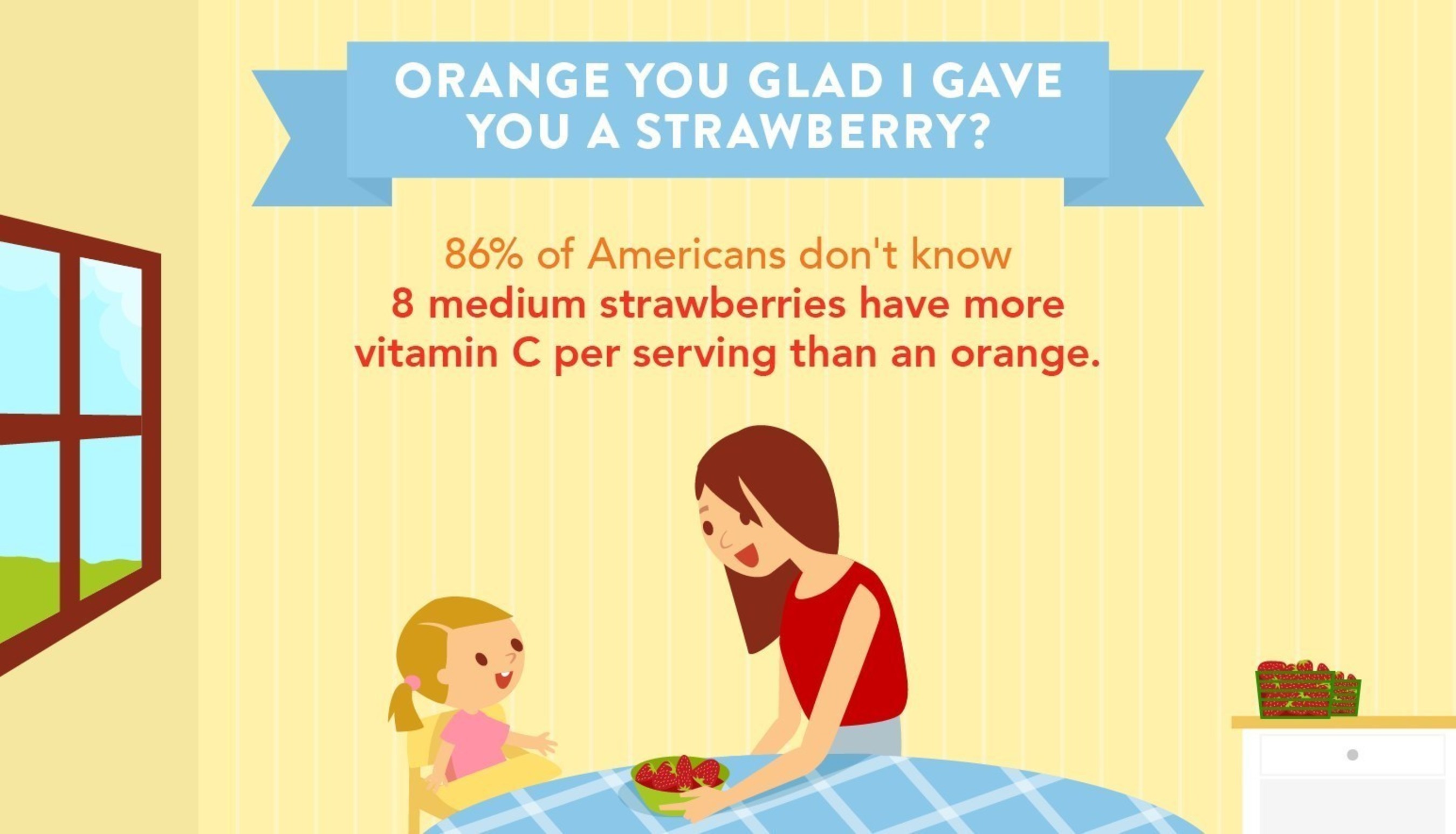
- Belief: Oranges have more vitamin C per serving than strawberries. Eighty-six percent of respondents thought oranges had the most Vitamin C per serving.
- Fact: A one-cup serving of strawberries has more vitamin C than an orange. Vitamin C is known for its antioxidant properties, helping to protect the body from oxidative stress.
For Your Kids
The survey also revealed that we aren't just neglecting this favorite superfruit for ourselves. The majority of respondents indicated they are most likely to pack fruit other than strawberries in school lunches – only nine percent indicated strawberries as their preferred lunchbox option. The vitamin C, folate, fiber, potassium and associated benefits make strawberries a great choice for keeping kids healthy. Get tips for simple lunchbox recipes here.
For Everyday
So why don't people eat strawberries more often? The survey indicates that most people maintain the belief that strawberries are a dessert-only treat. When respondents were asked when they are most likely to eat strawberries, the majority (37 percent) said "as a dessert," whereas only 14 percent said "as part of a meal." As few as three percent said that they're most likely to grab strawberries while on the move versus other fruits.
Registered dietitian Mitzi Dulan notes, "We're saving strawberries for dessert, but we're not taking advantage of the year-round availability of California strawberries and all the great health benefits they offer during the rest of the day. Strawberries are incredibly versatile and can be cooked, frozen, and blended for use in all kinds of dishes from breakfast through dinner."
Here are some helpful hints for ways to add a serving of California strawberries to your diet:
A strawberry can act like a tomato.Consider a Caprese salad made with fresh mozzarella and strawberries. Transform a grilled cheese-and-tomato sandwich into a panino with strawberries and a savory cheese like Provolone.
Strawberries are salad friendly.Add sliced strawberries to your favorite leafy greens. To create fresh twists on classic dressings, use puréed strawberries to stand in for some or all of the vinegar. They'll add tangy sweetness, body and aromatic appeal.
Strawberries pair perfectly with proteins.Top grilled chicken or fish with a fresh fruit salsa.
Frozen strawberries can be super ice cubes.Add frozen strawberries, instead of ice, directly to blender drinks.
Tuesday, April 21, 2015
Pet Parents and Furry Companions United in "One Health"
It's no secret that a large—and growing—majority of U.S. pet owners consider their pets to be part of the family, and this human-animal bond is one of the most important factors behind pet owners' willingness to spend generously on pet products and services, according to Packaged Facts, a market research publisher with a diverse catalog of reports on pet products and services. It's a trend that pet product marketers and retailers have catered to for several years. And these days the strength of the human-animal bond in which pet parents are willing to spend more to aid in the health and longevity of their companions has even begun to influence activity outside the traditional realm of services designed for pets.
Part of the reason why pet owners are spending more on their companions is because not only do they increasingly view their pets as family, but research indicates that an investment in their pets is also in many ways an investment in themselves. It's a concept that some experts in the medical industry refer to as "one health," or the idea that human health is connected to animal health and the environment. According to Packaged Facts' Pet Owner Survey data from January 2015, three out of four dogs owners report being healthier and happier because of their canine companions: 38% strongly agree and 36% somewhat agree that their dogs have a positive impact on their physical health, and 44% strongly agree and 36% somewhat agree that their dogs have a positive impact on their mental health. The ratings for cat ownership are nearly as thumbs up: 34% of cat owners strongly agree and 31% somewhat agree that their cats have a positive impact on their physical health, and 41% strongly agree and 33% somewhat agree that their cats have a positive impact on their mental health.
There are several examples over the past several years that point to the blurring lines between products designed for humans and those designed for pets. The shift extends not only to retail products such as human grade pet food, but also to the veterinary segment. For example, highly regarded Johns Hopkins University recently opened the Center for Image-Guided Animal Therapy. The new center allows Johns Hopkins to provide pets with many of the same advanced equipment and procedures that benefit humans, including imaging tools to diagnose pets and services involving image-guided biopsies and minimally invasive procedures. John Hopkins, renowned for its contributions to human medicine and unaffiliated with any veterinary schools, can now assist various veterinarians from outside practices who need to bring dogs, cats, and more exotic pet patients to the university for advanced diagnostic scans and therapies.
The cost for these imaging procedures is no small sum for pet owners, yet it's no surprise that so many pet owners are willing to foot the bill, especially considering that spending on veterinary services overall has been on the uptick. In the soon to be released reportU.S. Pet Market Outlook, 2015-2016, Packaged Facts estimates that the veterinary services segment (including pet products sold through the channel) is the pet industry's second largest, with $23 billion in revenue in 2014, up 5%. Solid growth is expected for the future, and the compound annual growth rate (CAGR) for the veterinary services segment between 2014-2019 is projected to be 5%.
Saturday, March 7, 2015
Don't Lose Sleep over Daylight Saving Time: Sleep experts recommend tart cherry juice to get a better night's sleep naturally
As clocks spring forward this weekend for Daylight Saving Time, Americans will lose one hour of sleep, which will likely have an effect for up to a week, experts say. An estimated 50-70 million adults in the U.S. already suffer sleep disturbances,1 and the additional hour lost further disrupts the body's internal clock and can reduce sleep efficiency, or quality of sleep.
 Americans' ongoing sleep problems have caused an uptick in the use of sleep aids, now an $84 million market. Rather than looking for solutions in the medicine cabinet, sleep experts suggest starting with your fridge.
"Take a look at your diet," said nationally recognized sleep expert Dr. Carol Ash, Director of Sleep Medicine for Meridian Health inNew Jersey. "Cut down on caffeine and alcohol, particularly in the evening, and instead of reaching for an extra cup of coffee in the morning, try drinking a glass of tart cherry juice at night."
Tart cherries are one of the few natural sources of melatonin, a compound with sleep-regulating properties. A growing body of evidence suggests tart cherry juice can help reduce the severity of insomnia and improve sleep efficiency, which is measured as a ratio of the total time in bed vs. actual sleep time.
"One of my goals as a sleep specialist is to help people become more efficient sleepers," said Dr. Ash. "The issue is not just getting the proper duration of sleep – it's about staying asleep once you've gone to bed, instead of waking up or tossing and turning throughout the night."
Tart cherries are quickly gaining recognition as a natural sleep aid alternative. Studies have shown that tart cherry juice made from cherries, the most popular U.S. varietal, may help improve both the quantity and quality of sleep. According to research, tart cherry juice may:
Montmorency- Help improve sleep efficiency. U.K. researchers found that young healthy adults who drank two glasses of tart cherry juice each day for a week slept about 40 minutes longer on average and had up to a 6 percent increase in sleep efficiency.2
- Reduce the severity of insomnia and sleep disturbances. A study conducted at the University of Rochester Medical Center found that drinking two 8-ounce servings of tart cherry juice daily for two weeks helped reduce the severity of insomnia and time spent awake after going to sleep among older adults with insomnia.3
- Increase sleep time. Researchers at Louisiana State University found that drinking Montmorency tart cherry juice twice a day for two weeks helped increase sleep time by nearly 90 minutes among older adults with insomnia.4
Researchers attribute the sleep benefits to the melatonin and phytonutrient content of tart cherries, including the natural compounds anthocyanins. Each serving of tart cherry juice used in the studies is estimated to contain the equivalent of 90 to 100 Montmorency tart cherries.
Tart cherries are available year-round in dried, frozen and juice forms (including juice concentrate), and are readily accessible on the shelves at a variety of retailers across the country and online. For more ways to Go Red before Bed, and to learn more about the many health benefits of tart cherries, visit www.choosecherries.com.
Subscribe to:
Posts (Atom)