Showing posts with label lifestyle. Show all posts

Tuesday, March 10, 2015

NAR Generational Survey: Millennials Lead All Buyers, Most Likely to Use Real Estate Agent

Despite the economic and financial challenges young adults have braved since the recession, the millennial generation represented the largest share of recent buyers, according to the 2015 National Association of Realtors® Home Buyer and Seller Generational Trends study, which evaluates the generational differences of recent home buyers and sellers.
The survey additionally found that an overwhelming majority of buyers search for homes online and then purchase their home through a real estate agent, with millennials using agents the most.
For the second consecutive year, NAR's study found that the largest group of recent buyers was the millennial generation, those 34 and younger, who composed 32 percent of all buyers (31 percent in 2013). Generation X, ages 35-49, was closely behind with a 27 percent share. Millennial buyers represented more than double the amount of younger boomer (ages 50-59) and older boomer (60-68) buyers (at 31 percent). The Silent Generation (ages 69-89) made up 10 percent of buyers in the past year.
Lawrence Yun, NAR chief economist, says the survey highlights the untapped demand for homeownership that exists among young adults. "Over 80 percent of millennial and Gen X buyers consider their home purchase a good financial investment, and the desire to own a home of their own was the top reason given by millennials for their purchase," he said. "Fixed monthly payments and the long-term financial stability homeownership can provide are attractive to young adults despite them witnessing the housing downturn and subsequent slow recovery in the early years of their adulthood."  
With millennials entering the peak buying period and expected to soon surpass boomers in total population, Yun believes the share of millennial purchases would be higher if not for the numerous obstacles that have slowed their journey to homeownership. "Many millennials have endured underemployment and subpar wage growth, and rising rents and repaying student debt have made it very difficult to save for a downpayment. For some, even forming households of their own has been a challenge."  
According to the survey, 13 percent of all home purchases were by a multi-generational household, consisting of adult siblings, adult children, parents and/or grandparents.                        
The biggest reasons for a multi-generational purchase were cost savings (24 percent) and adult children moving back into the house (23 percent). Younger boomers represented the largest share of multi-generational buyers at 21 percent, with 37 percent of those saying the primary reason for their purchase was due to adult children moving back into their house.
"Even though the share of first-time buyers has fallen to its lowest level since 19871, young adults in general are more mobile than older households," adds Yun. "The return of first-time buyers to normal levels will eventually take place in upcoming years as those living with their parents are likely to form households of their own first as renters and then eventually as homeowners."
Characteristics of Buyers
The median age of millennial homebuyers was 29, their median income was $76,900 ($73,600 in 2013) and they typically bought a 1,720-square foot home costing $189,900 ($180,000 a year ago). The typical Gen X buyer was 41 years old, had a median income of$104,600 ($98,200 a year ago) and purchased a 1,890-square foot home costing $250,000 (same as last year).
Seventy-nine percent of all buyers considered their home purchase a good financial investment, with millennials (84 percent) and Gen X (82 percent) having the highest share, followed by younger and older boomers (both 77 percent), and the Silent Generation (72 percent).
Generation X buyers (68 percent) were the most likely to be married, younger boomers had the highest share of single female buyers (23 percent), and millennial buyers were more likely (compared to other generations) to be an unmarried couple (14 percent).
When asked about the primary reason for purchasing a home, a desire to own a home of their own was highest among millennials at 39 percent. Younger boomers were the most likely to buy because of a job-related relocation or move, and a change in a family situation – likely the birth of a child – was the highest (13 percent) among Gen X buyers. Older boomers (at 15 percent) were the most likely to buy because of retirement.
Searching for and Buying a Home
Regardless of their age, buyers used a wide variety of resources in searching for a home, with the Internet (88 percent) and real estate agents (87 percent) leading the way. Millennials were the most likely to use a real estate agent, mobile or tablet applications, and mobile or tablet search engines during their search; Gen X buyers were the most likely to use an open house.  
Although the Internet was the top source of where millennials found the home they purchased (51 percent), they also used an agent to purchase their home at a higher share (90 percent) than all other generations.
NAR President Chris Polychron, executive broker with 1st Choice Realty in Hot Springs, Ark., says the survey results highlight the fact that while the Internet is widely used during the home search process, the local market knowledge and expertise a Realtor®provides is both valued and highly sought by buyers of all ages.
"Nothing can replace the real insights and guidance Realtors® deliver to help consumers navigate the complex buying and selling process," adds Polychron.
Although most purchases by all generations were in a suburban area, the share of millennials buying in an urban or central city area increased to 21 percent in the past year (19 percent a year ago), compared with only 12 percent of older boomers (unchanged from a year ago). Older boomers and the Silent Generation were more likely to buy in a rural area (18 percent each). Buyers' median distance from their previous residence was 12 miles, with older boomers moving the furthest at a median distance of 30 miles.
The majority of all buyers (79 percent) purchased a detached single-family home. Gen X buyers represented the largest share of single-family homebuyers (85 percent), and the Silent Generation was the most likely to purchase a townhouse or row house (10 percent). A combined 7 percent of millennial buyers bought an apartment, condo or duplex in a building with two or more units.
Among the biggest factors influencing neighborhood choice, millennials were most influenced by the quality of the neighborhood (75 percent) and convenience to jobs (74 percent). Convenience to schools was most desired by Gen X buyers and proximity to health facilities by the Silent Generation.
Millennials plan to stay in their home for 10 years, while the baby boom generation as a whole plans to stay for a median of 18 years.
Financing the Purchase
NAR's study found that 88 percent of all buyers in the past year financed their purchase. Millennials (97 percent) and Gen X (96 percent) were more likely to finance than older boomers (72 percent) and the Silent Generation (61 percent). The median downpayment ranged from 7 percent for millennial buyers to 20 percent for older boomers.
Younger buyers who financed their home purchase most often relied on savings for their downpayment, whereas older buyers were more likely to use proceeds from the sale of a primary residence. Younger buyers also were more likely to receive a gift from a relative or friend, typically their parents, cited by 25 percent of millennials and 15 percent of Gen X.
Twelve percent of all recent buyers had delayed their home purchase due to outstanding debt. Among the 22 percent of millennials who took longer to save for a downpayment, 54 percent cited student loan debt as the biggest obstacle – down slightly from 56 percent a year ago.
Younger buyers were more likely to finance their purchase with a low downpayment Federal Housing Administration-backed mortgage, whereas older buyers were more likely to obtain a mortgage through the Veterans Affairs loan program. 
Characteristics of Sellers
Gen X homeowners represented the largest share of sellers in the past year (27 percent), followed by older boomers (23 percent) and younger boomers (20 percent). The older the seller, the longer he or she was in the home. Millennials had been in their previous home for a median of five years, while older boomers and the Silent Generation stayed for 13 years.
Younger sellers were more likely to need a larger home or move for job relocation. In comparison, older buyers wanted to be closer to family or friends, said their home was too large, or were moving due to retirement.
The survey additionally found that Gen X sellers were the most likely to have wanted to sell earlier but were stalled because their home had been worth less than their mortgage (23 percent compared to 16 percent for all sellers).
Sellers moved a median distance of 20 miles, with boomers and the Silent Generation moving further distances and downsizing to a smaller-sized home.
A combined 60 percent of responding sellers found a real estate agent through a referral by a friend, relative or neighbor, or used their agent from a previous transaction. Eighty-three percent are likely to use the agent again or recommend to others.
While all sellers wanted help in marketing their home to potential buyers, younger sellers were more likely to want their agent to help with pricing the home competitively or selling within a specific timeframe.
NAR mailed a 127-question survey in July 2014 using a random sample weighted to be representative of sales on a geographic basis. A total of 6,572 responses were received from primary residence buyers. After accounting for undeliverable questionnaires, the survey had an adjusted response rate of 9.4 percent. The recent homebuyers had to have purchased a home between July of 2013 and June of 2014. Because of rounding and omissions for space, percentage distributions for some findings may not add up to 100 percent.
All information is characteristic of the 12-month period ending in June 2014 with the exception of income data, which are for 2013.
The 2015 NAR Home Buyer and Seller Generational Trends study is posted at:  http://www.realtor.org/reports/home-buyer-and-seller-generational-trends.
The National Association of Realtors®, "The Voice for Real Estate," is America's largest trade association, representing 1 million members involved in all aspects of the residential and commercial real estate industries.
1NAR's 2014 Profile of Home Buyers and Sellers found the share of sales to first-time buyers dropped 5 percentage points from 2013 to 33 percent, representing the lowest share since 1987 (30 percent).

Wednesday, February 18, 2015

Age Is Just A Number: Single, Female Baby Boomers Happier, Healthier Than Ever

The adage "youth is wasted on the young" doesn't apply to today's single, female Baby Boomers. In fact, 76 percent of single women over 55 feel younger than their age, according to new data from Del Webb, a national brand of PulteGroup, Inc. (NYSE: PHM), one of the nation's largest homebuilders.
The first data in a series of new results from the recently conducted Del Webb Baby Boomer Survey of single, Baby Boomer women, finds that 74 percent of respondents are as happy, or happier, than they were at age 35 and nearly half (45 percent) believe their best years are yet to come.  
Building specifically for homebuyers ages 55 and older, Del Webb is America's largest builder of active adult communities with more than 50 Del Webb communities in 21 states. Of the 76 million Baby Boomers, recent U.S. Census data shows that as many as 28 million (or 37 percent) are single females. Del Webb has conducted more than ten Baby Boomer surveys since 1996. The 2015 Del Webb Baby Boomer Survey is the first time ever that the company has exclusively surveyed this unique demographic to take a closer look at who they are and what really matters to them. 
"Boomer homebuyer preferences and trends have changed dramatically in the 55 years since the first Del Webb community opened, but none stand out more than this generation's movement toward an active lifestyle that rivals people half of their age," said Ryan Marshall, executive vice president of homebuilding operations, PulteGroup. "Single, female Boomers have emerged as a powerful demographic. They have diverse needs, and it is incumbent on us to develop communities that offer an overall experience that reflects all that they want out of life."
The study finds that the single, female Boomer demographic is incredibly confident. According to the 2015 Del Webb Baby Boomer Survey, not only do 80 percent of respondents rank having self-confidence as "very important," but 76 percent are more empowered now than they were at age 35.  In fact, more than one-in-five (22 percent) say they also feel more attractive than they were at 35.  
That confidence may be attributed to the fact that 54 percent of single, female Boomers are as active or more active today than they were at 35. The 2015 Del Webb Baby Boomer Survey shows that four-in-five (81 percent) of single, female Boomers rank being physically healthy as "very important," and 68 percent of respondents rank a healthy lifestyle as their first priority, after time with family and friends.  
Healthy lifestyle habits among this demographic include a number of high-energy activities, including some that may be unexpected. Nearly two-thirds (59 percent) of respondents report exercising at least a few times a week, engaging in activities including:
  • Weight training (27 percent)
  • Hiking (19 percent)
  • Yoga (18 percent)
  • Biking (16 percent)
  • Swimming (14 percent)
Other activities mentioned by respondents include tai chi, free-style dancing and horseback riding, among others.
"The lifestyle that single, female Boomers are embracing may be surprising to some, but it embodies what we see every day among our residents and prospective homebuyers," said Lindy Oliva, division president, PulteGroup. "Understanding that Del Webb residents demand a lifestyle defined by independence, vibrancy, engagement and fulfillment, has shaped the community designs and amenities offered in Del Webb communities for the past five decades."
Additional data on this dynamic demographic will be released throughout the year, including sentiments related to dating, home preferences and financial security/retirement. For more information, visit www.pultegroupinc.com.
About the Del Webb Baby Boomer SurveyThe Del Webb Baby Boomer Survey polled 1,020 single, female U.S. adults ages 50-68. The survey was conducted online by Nielsen from December 1-8, 2014. Findings for the total sample are projectable to the universe of 50-68-year-old U.S. females. At a 95 percent confidence level, a margin of sample error of +/- 4 percent applies to the sample. Since 1996, Del Webb has conducted more than ten Baby Boomer surveys to better understand this large, powerful demographic.  

Tuesday, February 10, 2015

Relationships Affect Homeownership, Say Realtors®

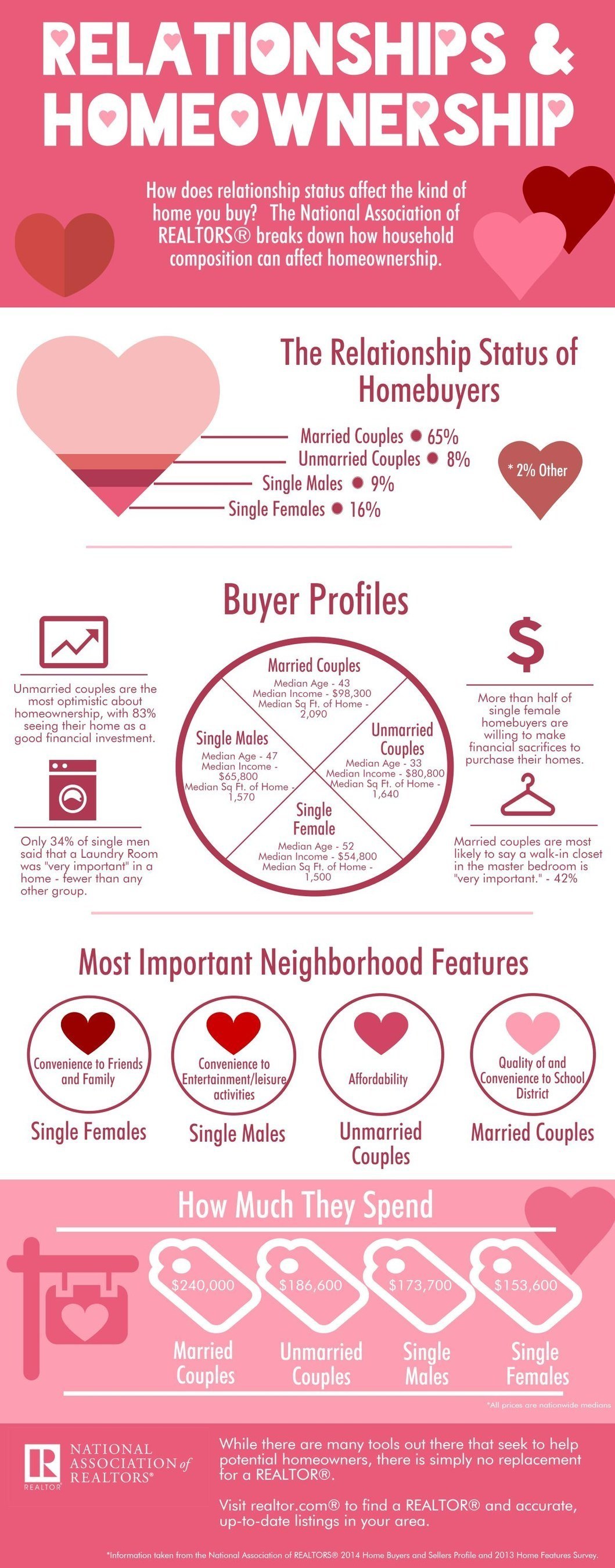
Whether married, dating or single, most Americans believe that owning a home is a good financial decision. According to a new infographic from the National Association of Realtors®, relationship status can affect when and where buyers purchase a home and how much they spend on it.
NAR analyzed the median age, income and size of home purchased for married couples, unmarried couples and single men and women; the infographic also shows the home and neighborhood features deemed most important by each group.
Data is from NAR's 2014 Profile of Home Buyers and Sellers, an annual report that evaluates the demographics, preferences, motivations, plans and experiences of recent home buyers and sellers.
For additional hig

Friday, July 25, 2014

Friday, July 18, 2014

Four Ways to Keep Homes Safer and More Energy Efficient While Owners Are on Vacation

Energy Education Council provides practical tips to cut electrical costs this summer

SPRINGFIELD, Ill., July 17, 2014 /PRNewswire/ -- Summer months are a popular time for many families to take a vacation. If you plan on spending time away from your home yet this summer, remember to prepare it for your absence. With the proper preparations you can cut electrical costs and keep your home and electronics safe while you are away.
"We want people to enjoy their vacations and keep their homes as safe and efficient as possible when they are away," said Molly Hall, executive director of the Energy Education Council and its Safe Electricity program.
The Council offers tips to help you prepare your home for vacation:
  • Change thermostat settings before you leave. When temperatures are warm outside, it is unnecessary to keep your home as cool as you normally would since you will not be in it. Turn the thermostat up to a warmer temperature or turn it off entirely. If you have a programmable thermostat, you can adjust it to cool down the house just in time for your return home.
  • Unplug appliances and electronics. You will not use your computer, television, or toaster while you are away, but they will use continue to use energy and waste money if you do not unplug them. Even when appliances are turned off, many of them go into standby mode and continue to draw power. Unplug appliances and electronics to prevent phantom power draw. This also protects your electronics if there is a power surge in your absence.
  • Adjust the water heater. The water heater can account for 15 to 25 percent of the average energy bill. Water heaters continue to use energy to keep the stored water warm. Since you are not using this water while on vacation, either adjust the water heater temperature to the lowest setting, or turn it off if you will be gone for more than three days.
  • If you plan on leaving lights on to deter burglars, put the lights on a timer. You can save money by not having lights on constantly and make it appear that people are home by varying the times the lights are on.
There are other ways to make your home more efficient throughout the summer, not just while on vacation:
  • Clean your air conditioning unit. Blocked or dirty air filters and coils can reduce your system's ability to push and pull air through vents, so make sure to wash or replace filters. Also remove debris from around the outside unit.
  • For inside lighting, use CFL or LED bulbs. Not only do they save energy, but they also give off less heat than regular incandescent bulbs, keeping your home cooler.
  • Make sure all air leaks are sealed. Inspect caulking around windows, doors, and any openings into the home. Weather stripping and caulking will help maintain your home's temperature.
  • Close your drapes or curtains during sunny or hot days. This helps prevent the summer sun from warming up your home through the windows.
  • Clean off ceiling fans, and make sure they are circulating air in the correct direction for the season. During warm months, ceiling fans should operate in a counter-clockwise direction. This creates a cooling effect at less cost than air conditioning. For more tips on keeping your home safe and efficient year-round, visit http://EnergyEdCouncil.org/.

Wednesday, July 16, 2014

Home Field Advantage: Glen Perkins, Minnesota Twins

Minnesota Twins pitcher, Glen Perkins talks about what makes his house feel like home in this edition of Coldwell Banker Home Field Advantage.


Saturday, July 12, 2014

Home Field Advantage: Dillon Gee, NY Mets Starting Pitcher

For NY Mets starting pitcher, Dillon Gee, home is wherever his family is. In this edition of the Coldwell Banker Home Field Advantage video series with MLB.com, the Gee family discusses adjusting to life in New York City.


Sunday, July 6, 2014

Friday, June 27, 2014

Home Field Advantage: Colby Rasmus, Toronto Blue Jays

Toronto Blue Jays center fielder, Colby Rasmus, shares what home means to him on this edition of Coldwell Banker Home Field Advantage.


Friday, June 20, 2014

Home Field Advantage: Adam Dunn

Chicago White Sox first baseman Adam Dunn shares what makes a house a home in this edition of Coldwell Banker Home Field Advantage.


Saturday, June 14, 2014

Home Field Advantage: Adam Jones, Baltimore Orioles

Baltimore Orioles outfielder Adam Jones talks about what home means to him in this edition of Coldwell Banker Home Field Advantage. Even as a MLB star, buying your first home is a momentous occasion


Thursday, June 5, 2014

Home Field Advantage: Steve Garvey, LA Dodgers

Former Los Angeles Dodger first baseman (1969-1982) and his wife Candace share their secret for keeping the family together at home. Take a sneak peek into the Garvey household on this edition of Coldwell Banker Home Field Advantage. 


Friday, May 30, 2014

Home Field Advantage: Johnny Damon, Boston Red Sox

Boston Red Sox outfielder Johnny Damon talks about what home means to him and gives us a glimpse through his front door on this edition of Coldwell Banker Home Field Advantage. As Johnny says, "Home is Forever.


Friday, May 23, 2014

Home Field Advantage: LaTroy Hawkins, Colorado Rockies

Colorado Rockies relief pitcher LaTroy Hawkins and his wife Anita offer a glimpse into their "home base" on this edition of Coldwell Banker Home Field Advantage. Welcome to casa de Hawkins!


Saturday, May 17, 2014

Home Field Advantage: CC Sabathia, NY Yankees

 New York Yankee starting pitcher C.C. Sabathia and his wife Amber explain what home means to them and offer a glimpse inside their NY home in this edition of Coldwell Banker Home Field Advantage. For CC, home is family.


Thursday, May 15, 2014

Home Field Advantage: Neil Walker, Pittsburgh Pirates

 For Pittsburgh Pirates' second baseman Neil Walker, home is where it all started. In this edition of Coldwell Banker Home Field Advantage, Walker gives a peek into his own home.


Thursday, April 3, 2014

2014 Coldwell Banker Previews International Luxury Market Report Ranks Hottest Markets Of The Year

MADISON, N.J., -- Beverly Hills, Aspen and South Beach, you have company! Locations just outside of historically affluent neighborhoods are becoming major players in the luxury housing market, according to the first Coldwell Banker Previews International® Luxury Market Index.  Woodside, Calif., home to venture capitalists and international entrepreneurs, was the top performing luxury market for 2013 based on critical metrics including annualized sales in units, volume and average and median sale price.
Woodside joined Portola Valley and Hillsborough, Calif., as Silicon Valley communities ranking in the top five, with all based less than 30 minutes from the Northern California corporate headquarters of Apple, Facebook and Google.  Bal Harbour, Fla., just eight miles north of South Beach, and Los Angeles suburb Thousand Oaks, Calif., rounded out the top five.
The index analyzes U.S. cities with at least 25 home sales of $1 million and higher in 2013 and compares the sales activity of the 100 top performing luxury real estate markets across the country*.
Below are the 10 best performing markets as rated by the Previews® Luxury Market Index:
Coldwell Banker Previews International Luxury Market Index
(Based on 2013 Sales)
Ranking
City
State
Index Value*
1
Woodside
Calif.
611
2
Bal Harbour
Fla.
600
3
Portola Valley
Calif.
573
4
Hillsborough
Calif.
567
5
Thousand Oaks
Calif.
565
6
Glenbrook
Nev.
555
7
Arcadia
Calif.
550
8
Southport
Conn.
544
9
Incline Village
Nev.
540
10
Atherton
Calif.
538
"Silicon Valley is the center of the technology universe, and buyers are flocking to our market to be a part of it," said Scott Dancer, a sales associate affiliated with Coldwell Banker Residential Brokerage in Woodside, Calif. "Inventory is very tight in markets likeWoodside, a reserved community with many homes hidden down long tree-lined driveways and private lanes, where 24 of Forbes' richest people in America own property. With inventory so low, we're also seeing the ultra-wealthy flock to other surrounding suburbs in the region, including Portola Valley, Hillsborough and Atherton depending on their lifestyle needs."
"Waterfront destinations have always been popular among affluent homebuyers, and the Miami area is no different," said Jill Hertzberg, who joins Jill Eber on the team of The Jills®, affiliated with Coldwell Banker Residential Real Estate in Miami Beach, Fla. "Bal Harbour is ideally situated on the northern tip of Miami Beach and attracts well-established buyers with its high-rise luxury condos, breathtaking beaches and high-end shopping.  These features, combined with the market's recent double-digit appreciation, make Bal Harbour a highly desirable location."
In addition to these hot luxury markets identified by the Previews® Luxury Market Index, the report also identifies the U.S. cities and ZIP codes with the most luxury home listings and sales. Below are the top 10 U.S. cities based on the number of home sales priced at $10 million and higher in 2013:
Coldwell Banker Previews International Luxury Market Report
Ranking
City
State
Number of $10 Million+ Sales in 2013
1
New York
N.Y.
43
2
Los Angeles
Calif.
27
3
Beverly Hills
Calif.
26
4
Miami Beach
Fla.
16
5
Aspen
Colo.
12
5
Palm Beach
Fla.
12
6
Malibu
Calif.
11
7
Greenwich
Conn.
8
7
San Francisco
Calif.
8
8
Atherton
Calif.
6
8
Montecito
Calif.
6
8
Laguna Beach
Calif.
6
8
Honolulu
Hawaii
6
9
Santa Barbara
Calif.
5
9
Naples
Fla.
5
9
La Jolla
Calif.
5
10
Newport Beach
Calif.
4
10
Pacific Palisades
Calif.
4
10
Wellington
Fla.
4
10
Newport Coast
Calif.
4
Honolulu, Hawaii, while tied for eighth with six $10 million-plus sales in 2013, has seen an uptick in luxury inventory on a famed stretch of Kahala Avenue, often referred to as the "Rodeo Drive" of the island.
"Known as the 'Gateway to the Pacific,' Honolulu is Hawaii's largest city and state capital, offering a thriving culture of international business and as of late, luxury real estate," said Anne Hogan Perry, a sales associate affiliated with Coldwell Banker Pacific Properties. "Affluent homebuyers from across the U.S. and international locations are coming here for our year-round tropical climate, natural beauty, lifestyle and melting pot of cultures."
MethodologyManhattan area active listing data has been gathered from the Real Estate Board of New York (REBNY). Not all Manhattan area real estate brokerage firms make information about their property listings available to any cooperative resource, including REBNY.
Manhattan area sales data has been gathered from REBNY and from StreetEasy.com, an on line consumer and private industry portal which reports closed real estate transactions from REBNY as well as other reporting brokerage resources. Not all Manhattan area real estate brokerage firms report their closed sales to any cooperative resource, including StreetEasy.com and / or REBNY.
All other data has been gathered from the Multiple Listing Service (MLS) databases known or believed to be the primary real estate broker cooperative resources for each market referenced in the report.
All closed sales activity reported is for the annual period January 1, 2013 through December 31, 2013. Closed sales reported to the MLSs significantly later than this analysis period will not be included. All active status listing records were downloaded and processed to the same standards, and on various dates, during the months of January and February, 2014.
Property-specific listing and sales records were standardized to USPS address city and ZIP Code, inaccurate list and sale prices were corrected when necessary, and all duplicate records were manually excluded. As a result, statistics available via the source data providers may not correlate to this analysis. While all results are believed to be highly accurate, MLS systems do not report all real estate activity in their primary marketplace, and there may have been property transfers not included in this analysis.
The index values represent a measurement of overall market activity limited to proper ties that have sold and had a list price at $1 million+. Index results are expressed in values in excess of 100. The higher the value in excess of 100, the more active the index market indicators.