Thursday, March 10, 2016

Survey Finds More Homeowners Planning Renovations in 2016


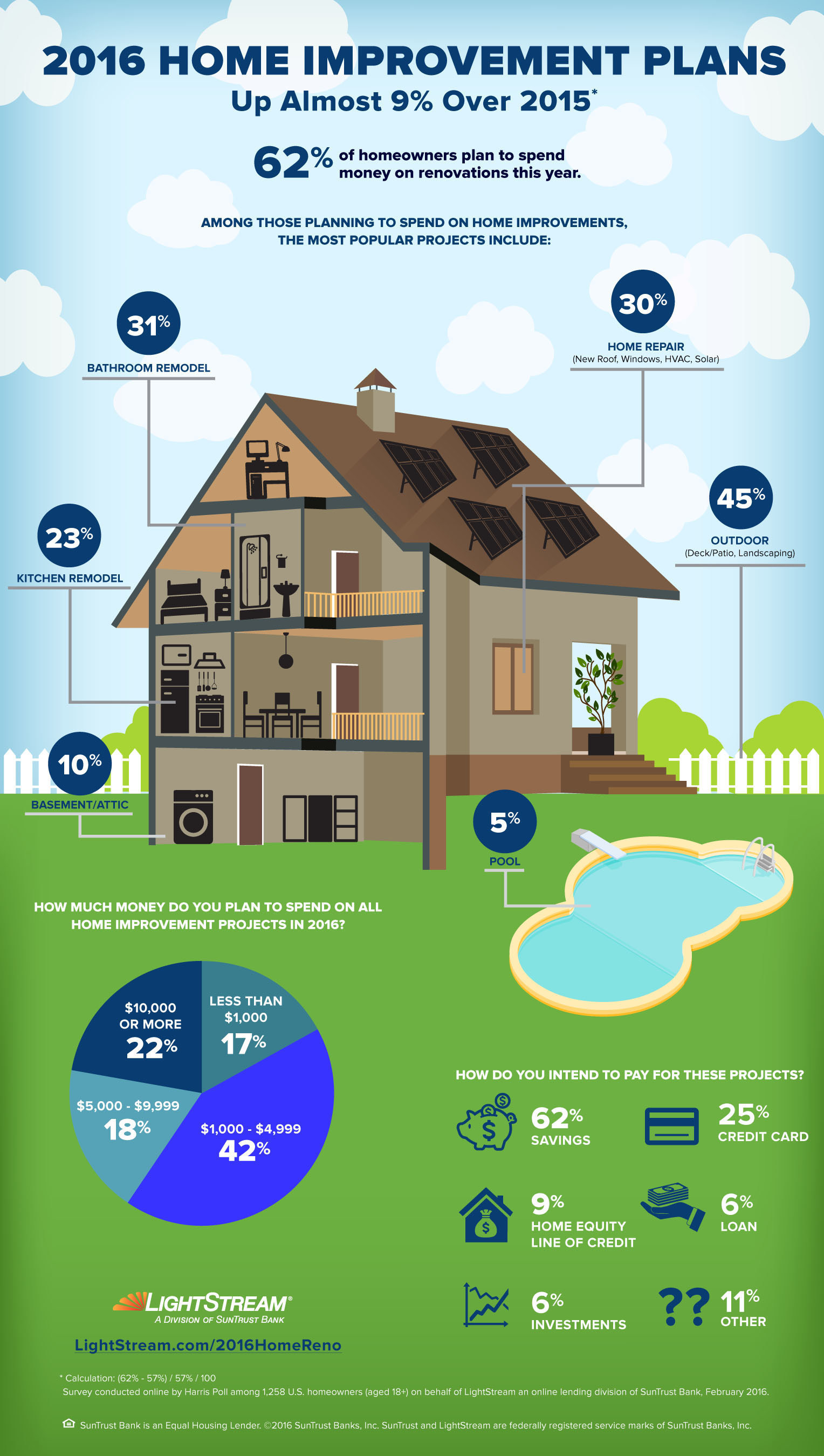
As the remodeling market continues to improve, more homeowners are taking on home renovation and maintenance projects and are open to spending even more money than last year. According to its third annual survey, LightStream, the national online lending division of SunTrust Banks, Inc. (NYSE: STI), found 62 percent of homeowners plan to spend on home improvement projects in 2016, an increase of almost nine percent compared to 2015.* The survey of homeowners was conducted online by Harris Poll in February 2016.
The amount that homeowners are looking to spend has also increased from years past. Overall, homeowners planning renovations this year will spend an average of $6,239 as compared to $5,037 in 2015. Forty percent plan to spend $5,000 or more (up from 36 percent in 2015) and 22 percent plan on spending $10,000 or more (up from 18 percent last year).
Once again, the desire to update a home's look, features and technology is the main motivation to remodel. The trend in outdoor living continues to dominate as the number one home improvement project with 45 percent investing in decks, patios or landscape renovations. Bathroom remodels (31 percent); upgrades to roofs, windows, HVAC and other technology systems (30 percent); and kitchen remodels (23 percent) round out the top four projects.
Sixty-two percent of homeowners planning renovations will pull from their savings. Credit cards will be used by 25 percent of homeowners; home equity lines of credit (9 percent), loans (6 percent) and investments (6 percent), are also cited in homeowner payment strategies.
According to research analysts at the Remodeling Futures Program at the Joint Center for Housing Studies of Harvard University, the challenge for 2016 will be whether the industry can find solutions to ongoing hurdles, such as consumer financing concerns. † 
"Home remodeling costs are often paid for with savings," said Todd Nelson, LightStream business development officer. "But as homeowners explore remodeling options, the scope of their renovation often grows. It's always important for people not to overextend themselves on any project. However, financing can be a great solution to supplement a budget, without incurring more expensive credit card debt or having to tap into investments. A home improvement loan or home equity line of credit can be a smart option, as today's continued low interest rates can underpin additional expenses and allow people to take advantage of the cost, time and labor efficiencies of doing their projects all at once."

Wednesday, March 9, 2016

Pet humanization continues expansion into pet-friendly travel and tourism

Have pet, will travel. The U.S. travel, tourism and hospitality industry is becoming increasingly more accommodating to pet owners seeking to bring their fur babies along on family vacations. According to market research publisher Packaged Facts in the report U.S. Pet Market Outlook, 2015-2016, pet humanization has been a driving force in market growth for the pet industry and as a result other U.S. market segments are eager to capitalize on the humanization trend's momentum.
"Every year, pet products manufacturers and retailers attribute the humanization trend with driving their business. The love people have for their pets means they want their pets to have the best whether that's human-quality foods, medicines, or even travel options and accommodations," comments David Sprinkle, research director, Packaged Facts.
Domesticated pet travel on commercial planes has been a standard for decades for most airlines. Now American passenger railroad service Amtrak is getting onboard with allowing pets on most of its trains, effective immediately. The recent announcement came after a four-month pilot program along the Northeast Corridor revealed that—surprise surprise—passengers wanted to travel with their pets. The primary caveat, besides additional traveling fees, is that only small dogs and cats (i.e., 20 pounds or less including the weight of the carrier) are permitted. Additional weekend-only restrictions apply for travel on Amtrak's high-speed rail service, the Acela Express.
On a related note, recent years have also seen luxury and budget hotels alike actively courting pet owners through a variety of pet-oriented amenities. An estimated 60% of U.S. hotels now accept pets, and that number jumps to 80% among luxury hotels, according to a 2014 survey by the American Hotel & Lodging Association. Who will be the next big company in the travel and hospitality sector to make room for pets? It's hard to say for certain, but it's clear that where pet owners go, their pets are more than likely to follow thanks to increased embracing of pet humanization.
Humanization is a natural expression of the "pets as family" trend, whereby pet owners treat their pets like children and are highly receptive to products similar to the ones they use for themselves. Not coincidentally, many of the services and products entering the market today are directly reminiscent of human fare, no doubt appealing to the pet owner as much as the pet. Examples include veterinary procedures like chemotherapy, MRIs, and hip replacements; pet supplements like glucosamine and omega 3s; human-grade pet foods containing superfruits or touted as gluten free; designer pet supplies; and luxury services including boarding options more like hotel rooms.

Tuesday, March 8, 2016

Labrador Retriever Reigns Supreme Once Again In Dallas

Once again, the Labrador Retriever took Dallas' top spot in the American Kennel Club's (AKC®) 2015 ranking of the most popular AKC-recognized dog breeds in the U.S.
The Lab was also recognized as the #1 pup in Houston, Newark, and Hartford.
Bulldogs, German Shepherd Dogs, and French Bulldogs gained in popularity in Dallas, all rising a spot to land at numbers two, three, and five, respectively.  The Golden Retriever and Yorkshire Terrier, however, fell out of favor in Dallas.  Both breeds dropped two spots, with the Golden Retriever landing at number four and the Yorkie at number nine.
"The Lab is holding tight to the top spot, but the Bulldog breeds are hot on its heels," said AKC Vice President Gina DiNardo.  "Both the Bulldog and its cousin the French Bulldog are friendly, playful breeds that are relatively easy to keep and make great companions for a variety of people."
Dallas' top 5 breeds for 2015:
Dallas' Most Popular Breeds 2015
  1. Labrador Retriever
  2. Bulldog
  3. German Shepherd Dog
  4. Golden Retriever
  5. French Bulldog
* Registration data pulled from Dallas zip codes as specified by U.S. Postal Service
The AKC today also announced its nationwide rankings.  The Labrador Retriever – an intelligent, family friendly breed – holds tight to the number one spot on the most popular list for the 25th consecutive year, continuing the longest reign as the nation's top dog in AKC history.
While the Lab is clearly America's dog, the French Bulldog is poised for a takeover.  The affectionate and playful breed continues to win the hearts of dog lovers everywhere, jumping three spots to number six in 2015.  The Frenchie has risen 32 spots over the past decade and shows no signs of stopping.
Most Popular Breeds Nationwide 2015
  1. Labrador Retriever
  2. German Shepherd Dog
  3. Golden Retriever
  4. Bulldog
  5. Beagle

Monday, March 7, 2016

5 Smart upgrades for the most-used rooms in your home

Kitchens, bathrooms and bedrooms are typically the rooms in any home that get the most use, which could also be why homeowners, when surveyed, consistently cite those rooms as the ones they most want to renovate. It makes perfect sense to upgrade the rooms where you spend the most time, but in high-traffic areas, you can't afford to make changes just for the sake of cosmetics. You want improvements that can enhance your enjoyment of a room and its functionality.
Here are five smart improvements to make in the rooms users of Ranker.com voted as the most popular ones in their homes: kitchens, living rooms, bedrooms, bathrooms and game rooms.
1. Add natural light
Most rooms in the home look better and are more functional in natural light, and more daylight can help reduce the need for artificial light. What's more, there's no arguing the positive mental and physical health effects of natural light. Daylight stimulates the body to produce Vitamin D and boosts brain levels of serotonin, which is thought to be associated with positive moods.
Adding skylights is a practical, cost-effective and attractive way to bring more natural light into virtually any room. Remote-controlled, solar-powered fresh-air skylights from Velux America provide not just natural light, but passive ventilation, a real plus in kitchens and baths. Adding solar powered blinds, in designer colors and patterns, increases energy efficiency while giving you total control over the amount of sunlight entering a room through the skylight.
In kitchens, Energy Star-qualified fresh air skylights increase natural light and ventilation without requiring any loss of wall space you could better use for cabinetry. In bathrooms, they provide the perfect combination of privacy and healthful natural light and ventilation.
If you already have older glass or plastic bubble skylights, you can upgrade to the latest solar powered models, plus solar blinds, and receive a 30 percent federal tax credit on the products as well as installation costs. You can even bring more natural light into rooms or areas without direct roof access, like half-baths, closets and hallways, with Sun Tunnel tubular skylights. Visit www.whyskylights.com to learn more.
2. Add organization/storage
Clutter and chaos not only make a room function less efficiently, it can impact your mood as well. Adding organization and storage to rooms where clutter typically collects — such as bedrooms, living rooms and game rooms — is an easy, cost-effective way to improve the function of the room and how you feel about spending time in it.
In bedrooms, maximize closet space by installing organization units. A variety of manufacturers offer ready-made units you can install yourself. Or, for a bit more investment, you can have a professional closet organizer custom-make a unit to fit your space and needs. In living rooms and game rooms, built-in shelving and cabinetry is a functional and beautiful way to improve organization.
3. Improve ventilation
Air flow is critical to the health of your home and everyone who lives in it. Ventilation in kitchens and bathrooms carries away excess moisture that can cause mold and mildew, and creates a fresher, more healthful environment by exhausting stale indoor air.
Bathrooms should be equipped with exhaust fans, and kitchen hoods should vent to the exterior of your home whenever possible. You can further improve ventilation by installing Energy Star-qualified, solar-powered fresh-air skylights, like those made by Velux. Because these skylights open, they provide passive ventilation to allow stale indoor air to escape and admit fresh air. A sensor operates a motor to close the skylights automatically in case of rain.
4. Replace older, inefficient fixtures and appliances
Fixtures and appliances are key elements of kitchens and bathrooms. Older ones not only look dated and shabby, they can cost you money because they use more electricity and water than newer, more efficient models.
Replacing old faucets, shower heads, dishwashers and washing machines with newer models that use less water can reduce your water bill and give kitchens and bathrooms a whole new look. Energy Star-qualified appliances such as stoves, clothes dryers, refrigerators and washers also use less electricity than older appliances, so you can also lower your energy bills.
5. Freshen the foundations
Every room benefits from a good foundation, and that doesn't just mean sturdy flooring. Wall color, flooring materials and trim are fundamental elements in any room. Simply repainting walls and woodwork can completely change the way any room looks. Or, if you like the colors you have, a fresh coat in the same color will make the room look brighter and newer. Replacing worn carpeting or dated tiles, or refinishing a hardwood floor are also great ways to improve the foundations of any room.

Saturday, March 5, 2016

Red Cross Has Resources to Help Keep Your Pets Safe This Winter

Winter weather can be hard on everyone. Low temperatures, snow and ice can be especially difficult for pets. The American Red Cross has resources available to help ensure pets' safety when cold weather hits and reminds everyone that if it's too cold for you, it's too cold for them.
"Our pets are members of our family, and the fact that they can't tell us what they are feeling can make them the most vulnerable members when cold weather hits," said Deborah C. Mandell, VMD, DACVECC, member of the American Red Cross Scientific Advisory Council, and staff veterinarian and professor of emergency and critical care, academic clinician at Matthew J. Ryan Veterinary Hospital of the University of Pennsylvania. "There are some simple steps any pet owner can take to make sure pets stay safe. And for lifesaving information at the touch of a finger, the Red Cross offers its free Pet First Aid App, which is a great resource for owners of pets and other animals."
Dr. Mandell recommends bringing your pets inside during cold winter weather. If you have outdoor animals or livestock, she advises moving them to sheltered areas and making sure they have access to non-frozen drinking water and that sources of food and water are not blocked by snow, ice or other obstacles.
The following tips on winter pet safety are provided by The Humane Society of the United States:
  • If pets cannot come indoors, make sure they are protected by a dry, draft-free enclosure large enough to allow them to sit and lie down, but small enough to hold in the pet's body heat. Raise the floor a few inches off the ground and cover it with cedar shavings or straw. Turn the enclosure away from the wind and cover the doorway with waterproof burlap or heavy plastic.
  • Salt and other chemicals used to melt snow and ice can irritate a pet's paws. Wipe their paws with a damp towel before your pet licks them and irritates their mouth.
  • Antifreeze is a deadly poison. Wipe up spills and store antifreeze out of reach.
Downloading the Red Cross Pet First Aid App gives users instant access to expert information on how to maintain their pet's health and what to do during emergencies. Users have access to instructions, videos and images for more than 25 common emergency situations for animals. In addition to learning about what to do for cold- and heat-related emergencies, users can also learn how to treat their pet's wounds, control bleeding, and care for breathing and cardiac emergencies.
For more information on how to prepare for winter weather, visit the winter storm safety information section on www.redcross.org.

Friday, March 4, 2016

Paint Color Can Create Just The Right Mood

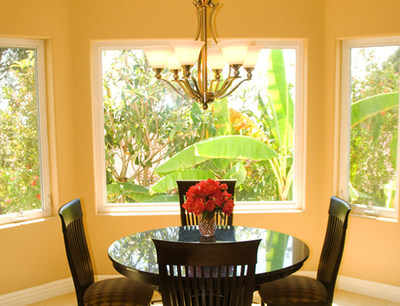
From a psychological standpoint, the best paint colors to use in a breakfast area are bright yellow or orange.  These "energizing" hues can have a positive effect on your mood and outlook, according to the Paint Quality Institute.Choosing paint color for a room in your home? Don't ignore the psychological impact of color. Studies have shown that different hues create different moods; they can even affect behavior!
"There are lots of good reasons to select a particular paint color, including personal preferences and design considerations, but often overlooked is the psychological power certain colors exert on mood, attitude, and outlook," says Debbie Zimmer, paint and color expert at the Paint Quality Institute.
"Even before you go to the paint store or start to look at color cards, think about the mood you'd like in your surroundings," advises Zimmer. "Do you want the space to be relaxing or invigorating? Once you make that decision, the color choice becomes easier," she says.
If your goal is to create a tranquil space, then favor a soft green or pale blue. These are the most calming colors, so they're ideal for rooms where you rest and relax – the family room or bedroom, for example. As a bonus, light blue and green tints are expected to be in vogue this year.
Other "go-to" colors for rooms where you go to rest – again, the bedroom or a sitting room, perhaps – include certain beiges, browns, and taupe. More enveloping than blues and greens, these quiet tints and shades impart more warmth and coziness to a space.  
At the other end of the psychological spectrum are paint colors that can inject energy into your surroundings. 
Yellow is the best example. Like a splash of brilliant sunshine, yellow walls can lift the spirit and brighten your outlook. What better color to use in a kitchen or breakfast area where you start the day?
Shades of orange – tangerine and apricot, for example – are also energizing, so they too are good choices for rooms where you spend your mornings. 
Reds are energizing, too, but they need to be used sparingly, since their bold appearance can literally increase heartbeat. But if you're seeking a great dining room color, look no further: Studies show that red can actually increase appetite, which explains why it is used in so many restaurants. 
Aside from the pure color, or hue, of the paint you choose, keep in mind that tone, or brightness, also plays a role in creating mood. Brighter tones invigorate, while those that are muted ("toned down") tend to be more relaxing.
After carefully choosing the perfect interior paint color, make sure it continues to look just so by applying the highest quality paint. According to Zimmer, top quality paints made with 100% acrylic resist fading, so the color you apply is the color you'll continue to enjoy for years to come.     
To learn more, visit the Paint Quality Institute's newly designed blog at blog.paintquality.com. It's an attractive, informative, easy-to-use resource for all things related to color and painting. 

Thursday, March 3, 2016

Geometric patterns, tarnished metals and jewel-tone hues are trending design focuses for 2016

The Delta Faucet Company industrial design team highlights the leading style preferences in its 2016 interior design trend report, capturing a range of looks, from soft, graceful patterns to bold, jewel-inspired furnishings. Knowledge of the latest trends within this ever-changing industry remains a top priority for the company as homeowners, designers and builders seek ways to reinvent their living spaces.
“Whether effortlessly combining two unique styles or breathing new life into a classic design, our industrial design team remains diligent in researching emerging trends and consumer preferences,” said Judd Lord, Delta Faucet Company senior director of industrial design. “A keen attention to detail and eye for design are key to creating products that truly inspire and impress in the home.”
The Delta Faucet Company design team travels the world in search of inspiration for the next Delta® and Brizo® collections. Along the way, they collect insights to share with builders, designers and homeowners alike as they work with consumers. The following trends will fuel the design industry in 2016, according to the Delta Faucet Company industrial design team:
2016 Interior Design Trend Report
  • Delicate Victorian: Graceful patterns, subtle pastel hues and white-washed woods work together to create a timeless Victorian-era aesthetic with a softer touch. This classic design has a place in modern spaces when traditional accents like delicate filigree patterns and soft colors are placed in open concept designs. Homeowners accessorize through feminine-shaped vases, rose gold accents, golden brass finishes, and patterned textiles. Within this trend, the team sees an emphasis on floral and hexagonal patterns that truly bring the understated, elegant style to life.
  • Reclaimed Rustic: Cool metals combine with warm botanical patterns to create the perfect blend of strong, industrial design with country comfort. Tarnished metals and textured stone juxtaposed against repurposed wood, nubby linens or country silks create rugged-yet-comfortable spaces. Reclaimed wood accents, bursts of poppy and browned brass finishes bring a balance of warmth to the cool, modern metals.
  • Colorful Contemporary: Soft, geometric shapes accompany bright hues and natural fabrics for a cheerful, modern look. Influenced by mid-century aesthetics, this design sits squarely at the intersection of urban and suburban. Stylized subway tile and playfully shaped furniture in loud colors like coral or bright yellow are on the rise. Homeowners with a desire for additional natural elements may consider lightened, walnut wood accents or even copper framed storage units with pale ash shelving.
  • Jeweled Luxury: Deep purple and navy hues, angular patterns and polished chrome finishes all create a luxurious look. Taking elements from both modern and traditional design, this look incorporates clean, geometric shapes and open, wirework furniture with faceted surfaces and marble flooring. Jewel-inspired details and finishes in buffed gold with subtle iridescences give the sense of long-lasting opulence.
For additional design inspiration and advice, visit DeltaFaucet.com/inspiredliving.